

An Interview with John Heiss
John Heiss is an active composer, conductor, flutist, and teacher. His works have been performed worldwide, and Winsor Music will give the world premiere of the oboe version, created for Peggy Pearson, at its first concert tonight, October 4th, 7pm at St. Paul's Church in Brookline, MA. Tickets are available in advance at discounted prices until 6pm. Professor Heiss shared his thoughts on the composition process, the history of this piece, and how each of us can learn and love new musical languages.
John Heiss is an active composer, conductor, flutist, and teacher. His works have been performed worldwide, receiving premieres by Speculum Musicae, Boston Musica Viva, Collage New Music, the Da Capo Chamber Players, Aeolian Chamber Players, Tanglewood Festival Orchestra, and Alea III. He has received awards and commissions from the National Institute of Arts and Letters, Fromm Foundation, NEA, Rockefeller Foundation, Massachusetts Council on the Arts and Humanities, ASCAP, and the Guggenheim Foundation. His principal publishers are Boosey & Hawkes, E.C. Schirmer, and Elkus & Son. Heiss has been principal flute of Boston Musica Viva and has performed with many local ensembles, including the BSO. His articles on contemporary music have appeared in Winds Quarterly, Perspectives of New Music, and The Instrumentalist. Along with Juilliard faculty Joel Sachs, Heiss has designed and written a book/CD-Rom classical music primer for Blue Marble Music entitled Classical Explorer. Starting in the 1970s, Heiss has directed many NEC festivals dedicated to composers or themes, and has spearheaded visits to NEC by many composers, including Ligeti, Lutoslawski, Berio, Carter, Messiaen, Schuller, and Tippett. Microcosms was given its world premiere as a string quartet on June 12, 2015 at NEC; Winsor Music will give the world premiere of the oboe version, created for Peggy Pearson, at its first concert tonight, October 4th, 7pm at St. Paul's Church in Brookline, MA. Tickets are available in advance at discounted prices until 6pm.
Thank you so much for sitting down with me today. I saw in a past interview that you gave about Whimsies that it contains “in-jokes” that makes the performers laugh and that are enjoyed by the audience. Are there these in-jokes in Microcosms, since it’s related to Whimsies? Can you explain that relationship?
Microcosms is derived from Whimsies, which I wrote for Fenwick Smith. He commissioned it in 2001; he said: “Make it light-hearted” and I said: Great, that’s just the mood I’m in anyway, I’ll do that. A Whimsy is a short, kind of epigraphical saying which brings a smile. Benjamin Franklin has many of those. I thought to do some short movements, in fact, some very short movements, and to make something large as a compilation of short things. As I got going, the movements, although they began with things that were quite brief, opened out, and became a little more full. There are eight movements in that piece and there are eight movements in this [Microcosms]. What I thought, for the last thirteen years, when Peggy talked to me about doing a piece, was that this was a good flute and piano piece, and then I thought: Wait a minute! This could make a terrific string quartet! There’s a lot of harmony, a lot of what I might call… not just chromatic harmony but sort of poly-triadic harmony, chords that are really groovy but that contain maybe at least two triads, two different ones put together. I thought about the jazz pianist Bill Evans, of course. Ligeti’s étude dedicated to Bill Evans, in Volume One of the Études, No. 5, called “Rainbows” — it’s a marvelous understanding by Ligeti of the idiom of jazz, which I grew up in. I was a saxophone player, played the piano, and of course played the flute primarily, but I led bands and all that. So I got to thinking about how to set the piece in the new clothing in such a way that, now that it’s a string quartet, it really isn’t a flute piece anymore, or even close.
Some other composers have done that occasionally — Stravinsky or Ives, two of my favorites, will tend to reimagine a piece of theirs, and provide a different context, a different instrumentation, and a different title! Stravinsky’s early five-finger piano pieces called “Les Cinq Doigts” (The Five Fingers), he orchestrated about forty years later for a chamber ensemble, somewhat close to the orchestration of the Dumbarton Oaks concerto. He made a piece that he called 8 Instrumental Miniatures, and now instead of just one player, there are fifteen players. Instead of the sequence of movements that he originally started with, it’s a different sequence, and there are segues in between the movements. It’s somewhat like the Berio Folksongs: taking a given material and fantasizing about it and inventing something that casts it in a very new light. So I’m very happy about the piece — it sounds great as a string quartet. I was stunned, even. And it really is a string quartet, and it’s my first! I waited until I was 75 to write a string quartet, I should have done that fifty years earlier, because this piece has had many performances already! The group that commissioned it has already played it six or seven times; the Borromeo String Quartet is doing it on October 20th here at school; there’s a wonderful quartet up in Maine that’s going to do it this fall, and then I’ve had several other inquiries from people that would like my score, and I’ve sent it out, and I think there are going to be four or five other performances around the country. And then, of course, Peggy asked for a transcription where the oboe takes the first violin part, which is not quite the way it turned out. I gave the oboe those things which are the most oboe-like, and at some point, she’s covering for any one of the instruments, really. But you know, I feel like Elliott Carter when he wrote his first percussion ensemble piece (it’s called Tintinnabulation) for us in 2008. Well, Elliott Carter was then 100. I sat with him when he was hearing it for the very first time at our dress rehearsal, with Frank Epstein conducting, and he laughed and laughed and laughed. So I turned to him and said: “Elliott, what are you laughing about?” And he said, “Oh, John, it works!”
I feel the same way about my piece here: it does work! And the first performance was here [the New England Conservatory] in June, June 12th, I think it was… nine days, as it turned out, before Gunther [Schuller] passed. It was a very uplifting and happy experience for me, and the women that commissioned it were former students at the Conservatory, and they played it very well. So now all of a sudden there is this firestorm of interest, and I’m going to tell every young composer I meet now, “Write a string quartet, because there will be multiple possibilities for performance!” I came to write something based on an old piece that became a new piece. It gives me great pleasure to think about how it’s going to sound with Peggy playing! She even called me this morning, and there’s one glissando that she can’t do, and she played this magnificent triple stop, and it was four or five notes in the same single sound, and she said: “Would that do?” and I said: “Would it!” and then we were talking about the pitches. Two of those notes that she played in that multi-phonic actually lead right into the last chord, and she wondered how that chord should be scored, if she should take one of the notes in that chord. I said no, we could distribute the strings, two notes for the cello, two for the violin, and two for the viola, so it’s a polychord — what I call a poly-diminished chord, with two diminished chords or maybe even three, I can’t remember which way it works. When you pile up tritones, you get kind of a buzzy dissonant sound, but this is a very harmonic chord. I think, from the conversation I’ve just had with Peggy about two hours ago, that the way we just settled on it now is going to sound great in the concert on October 4th.
I’m very happy that piece exists, I’m looking forward to hearing it with different players, and in the new transcription that Peggy coaxed me into, and that’s how it came to be. But it has an element of humor, of “whimsy,” and there are some in-jokes in it, which I think make it funny to the musicians in ways that the audience will perceive as funny without maybe knowing why. At one point in a movement called “Octatonic” there’s a quote from the Symphony of Psalms. It’s the figure Stravinsky uses in the first movement, very much sped up, and in a context of humor rather than sobriety, which is not the way Stravinsky imagined it. But people hear that — when Fenwick heard it, he burst out laughing and couldn’t play for a minute. I have tended in my music to let little figures, of other peoples’ music that I love, just come right in. I don’t look for them or try to put them in, they come to my mind while I am composing, and I think “Oh, good, that one wants in.” And I say, “Ok, you can come.” I say to the musical figure, “Welcome to my piece,” and then it becomes part of my piece. What I’m doing in that instance is very important, I’m not borrowing it. Stravinsky said: “Don’t borrow, only steal.” And when you steal, you get to keep it. And that means it belongs in your piece. He said that’s the way to pay homage to something else that you treasure. I’ve always felt that. It happens in jazz, too. So the piece is going to be played by Peggy and the people in her ensemble on October 4th, and we’re going to have a good time finding out about how well that works, but I’m pretty sure it’s going to work.
You were comparing the movements in Whimsies to little epigrams…?
A stitch in time saves nine; people who live in glass houses shouldn’t throw stones; a rolling stone gathers no moss; penny-wise, pound foolish; and then my favorite of Franklin’s — have great insight before marriage, and have (somewhat) of a blind eye afterwards. That’s not quite the quote but it’s something like that.
The reaction that is elicited by those epigrams or pieces of whimsy, is it driven because it’s something a little familiar, something that plays with our idea of reality?
Maybe, it plays with our idea of what should be happening at that point in time.
So that concept of “whimsy” speaks most directly to the musicians, as you say, because they’ll have the reaction that Fenwick did when he heard that quote — or theft? — from the Symphony of Psalms. We as an audience who are not performing or dissecting or even recognizing those musical quips...
You’ll still pick up something.
Because we read the musician’s reactions?
Right. I’ll tell you what I put in the score at one point. There are two people trying to do “cuckoo, cuckoo” and then someone else [a third person] is trying to do it faster and on different notes. And they get into an argument and each one tries to block the other one out. So I wrote in the score, during a little pause, “Quick competitive look at each other.” And so they glare and then try it again, and the audience laughed. And they laughed at the performance, of course. So, that’s a little touch of theatre. I might add, too, that the whimsies are serious, as epigrammatic humor sometimes is. It’s like Ives used to say, “It’s very important, if you can achieve it, to be both funny and serious at the same time.” Also as the piece unfolds, especially in the latter two or three movements, it begins to be a little more sober, if you will, but it’s still embracing the humor element, while looking at it maybe like Haydn would look at it: it’s a joke, it’s a great joke, but it’s part of a terrific symphony.
Let me give you the titles [of the movements] because they tell you a lot. I wrote only in clustered harmony with half-steps and whole-steps in the first movement, so I simply called it “Clustered.” The second movement is a little canon, an imitation, just for two voices, but made into four voices with the quartet, of course, so you get to hear it with much more richness via octaves that you wouldn’t hear in the original. I called it “Diatonic-Canonic.” It’s also got a Renaissance cadence at the end that usually makes everyone laugh. All of a sudden, there are Machaut and Landini smiling at you from the fourteenth century! It’s the cadence where the melodic voice goes “8-7-6-8” and then “2-1” underneath then “sharp 4-5” in an inner voice, which makes it sound like it couldn’t possibly come from anything in the tonal period. I was writing along, I thought, here I need an ancient cadence. So I did that. That, too, made some people laugh. It sounds kind of weird, like it’s meant to be, but where did that come from? And I would say, from six hundred years ago.
The third movement is called “Enharmonic,” meaning there’s a long G-sharp in the beginning of the piece, which changes to A-flat, and back to G-sharp, and back to A-flat, and I have the oboe, or the principal player, first violin, or whoever it is, play melodic lines that consist mainly of tones whose harmony is changing their meaning right while they’re being played. As you know, a C# and Dflat are of course the same note, the same pitch on the piano, but they have a completely different universe of color and meaning. So “enharmonic” means the possibility of a tone having different meanings depending upon how it’s set. Once you start playing around with that, one note can be harmonized about seven or eight different ways. So I got going on that as an idea, and I wrote the piece called “Enharmonic,” which is not as funny, maybe, as some of the other pieces, but it’s got a little twist to it.
After “Clustered,” “Diatonic-Canonic,” Enharmonic,” comes “Octatonic” — that’s the eight-note scale that pervades the work of a lot of composers from the first half of the twentieth century: Stravinsky, Bartók and Messaien in particular. Then after this, I wrote “Lyric” - a soaring melody with wonderful, strange, jazz-harmony flavors underneath it. Then I wrote the movement that has the cuckoo sound in it, and that movement is called “Stuck.” So now, here’s a “K.” There’s a program note for that: “Waltzes are everywhere, but so are cuckoos.” Remember, the upper two notes of a waltz figure are the cuckoo’s notes; these can be a calling interval in music. So I made a pun on falling thirds and how they beckon you.
Then I thought: we’d better have a different movement, after Clustered, Diatonic Canonic, Enharmonic, Octatonic, Stuck — and the next movement is called “Free.” This one is more improvisational and more investigative of odd sonorities. Each player gets to have a little solo and they kind of interact a bit, but it’s more about larger spaces between the players and larger spaces between the gestures in the music.
Next, I was wondering how to finish, and it hit me right away what to do. The last movement of Pierrot Lunaire is called “O alter duft,” “Oh olden fragrance from days of yore, return to me again, and intoxicate my senses as you did in my youth.” It’s about the return to, or the desire to have, tonality come back. It’s very wistful, and nostalgic, it’s a hauntingly beautiful movement. Pierrot is of course, forty-five minutes of the greatest music that’s ever been written, and it ends that way, with a kind of haunting nostalgia. It almost makes a cadence in E major, the key of his [Arnold Schoenberg’s] chamber symphony, but it doesn’t quite do that. So I tried to get the same idea of getting almost in a key, but sorry, not quite. You remember those things, keys, right? I always think of my colleague, Stephen Drury, he would look at a score and say, “Oh look, that’s one of these things with key signatures.”
So I wrote a movement called “Homeward Bound.” Schoenberg’s movement is called “O alter duft” but “Homeward Bound” means coming home, as he was trying to imagine doing but knowing that you weren’t going to be able to, in the modern world, recover that. I wrote “Homeward Bound” (Fantasy on Pierrot) as an homage to that movement in the Schoenberg and I think I’ll be immodest and say that it’s maybe even as good as the Schoenberg. It is for me. And I say that with humility. My piece uses quite a lot of his material, but only by stealing it, not by borrowing it. It’s illusory and allusive. Perhaps you’re thinking: “This is lyrical.” There’s a sense of the players re-joining after the movement in which they were separated. It has what I will call the harmony of atonality, which is, when there is harmony, and I think there always should be, it is haunting and beautiful and alluring.
I’m glad you mentioned the pull between tonality and atonality, because I wanted to ask you about an interesting quote I saw in one of your other interviews having to do with this negotiation between musical languages at a turning point in history. You referenced Monteverdi as being someone who was moving between languages, and who was using both languages, and very much engaged with both, and also being this pivotal person who defined the shift between them…
Yes, he did that, as a 35-year-old - he was born in 1567, so when he was 32, on January 1st, 1600 the bell rang, and said “It’s time for the Baroque!” — and it happened almost that fast. Within a few years, everyone was aware that there was a new current, and something new going on — there’s Monteverdi, young enough to be a leader in that development. And that’s a macro-development for the whole history of music, from modality to tonality, into bar-lines where it had been more freely notated, the use of continuo, the development of opera, the use of something called a “chord,” a much more heightened emotional immediacy than had ever been the case before, and drama!
What we’re all trying to do, I think, is to communicate something that we feel strongly about, and something that may have an aspect that’s somewhat new. And we hope that we get a good performance, and an appreciative audience, and then art can develop and advance. Monteverdi was a big player in that, Schoenberg was too. He began as a Romantic and ended as an atonalist, so he had to make that change in his mid-life also. I think people who are already in their 30s and have a big change happening right around them at that time (which is what happened to Schoenberg, too) are young enough to be “hip” enough to make the change, but old enough to have the craft to enable them to do it. Look at Stravinsky’s development, too, during his life. He was always looking for something new. He was Russian and then he became neoclassic and then he became serial, and the late works, in a way, are the crown of his career — well, a lot of people don’t think so, but I do.
It’s been my experience that musicians learn a musical language by inhabiting it, that for most of us (with some exceptions) it’s not just listening to a new language that imprints it on our ear, it’s the doing. If you listen to something your whole life, especially during formative periods, and if you listen to it often enough, you come to live in that language. But for the average or even more-than-average concert-goer, how do they become acclimated to a new musical language when they perhaps don’t have the opportunity to inhabit and dissect the music as the musicians do?
Bring an open mind, read the program notes, listen to what the composer had to say, ask the players, and keep doing it over and over and over again. Look for something new and see if you get rewarded for it. Many times if the piece is high quality you will be deeply rewarded by something you never encountered before. We’re in a good time right now. There used to be such hostility to the contemporary composer. I think we’re getting past that. The opportunity is right out there in front of you, and be motivated — you’ll always hear something better, by the way, the second time you hear it instead of the first time. You pick up more. So repeated listening can help a lot. And have faith. I think that’s the other thing. Have faith that the composer needs you and is hoping that he or she will have had the chance to be understood, and they’re not trying to put themselves above you or put you off. It’s about personal expression and outreach, those two things go together.
What exactly goes into making this an oboe version as opposed to a string quartet?
Most composers are in love with the instruments, especially with the voice, which is maybe the supreme instrument of all. I always say to my students: “There is nothing in this life like a soprano.” Or a mezzo, or a contralto, or a tenor, or a baritone! Somebody who can open his or her mouth and produce magic. And it touches you immediately. When they are sensitive to what they’re saying, their power of evocation is almost like nothing else on this planet. Ingmar Bergman, the Swedish film director, said “I am always trying to capture the mystery of the intangible in life, but I’m only a filmmaker. The people who can do that best, in ascending order of importance, are the saints, the poets, and the musicians.” He said “They know something that we don’t know! And you ask them to tell you what they know and they can’t, they just pick up their instrument and play.” I always think of Mendelssohn’s great quote about the meaning of music: “A piece of music is not too vague to be put into words, but oh, far too precise.”
The oboe is a beautiful instrument and Peggy is a beautiful player of that instrument. She’s identified with that, she’s one of the great oboists we’ve ever had. So I think about the instruments and what they sound like and what they can do, and if you treasure that in the right way, you’ll make a piece that pays homage to that and utilizes it, to help enhance your own speech. The instrument is the vehicle through which you can speak. And so I was very glad for Peggy’s request, and I’m trying to hear my piece in my inner ear now as an oboe piece instead of a full string quartet, and I bet that I’m going to get confirmation when I do. You just listen to Peggy play a little bit, you know what to do with your pen.
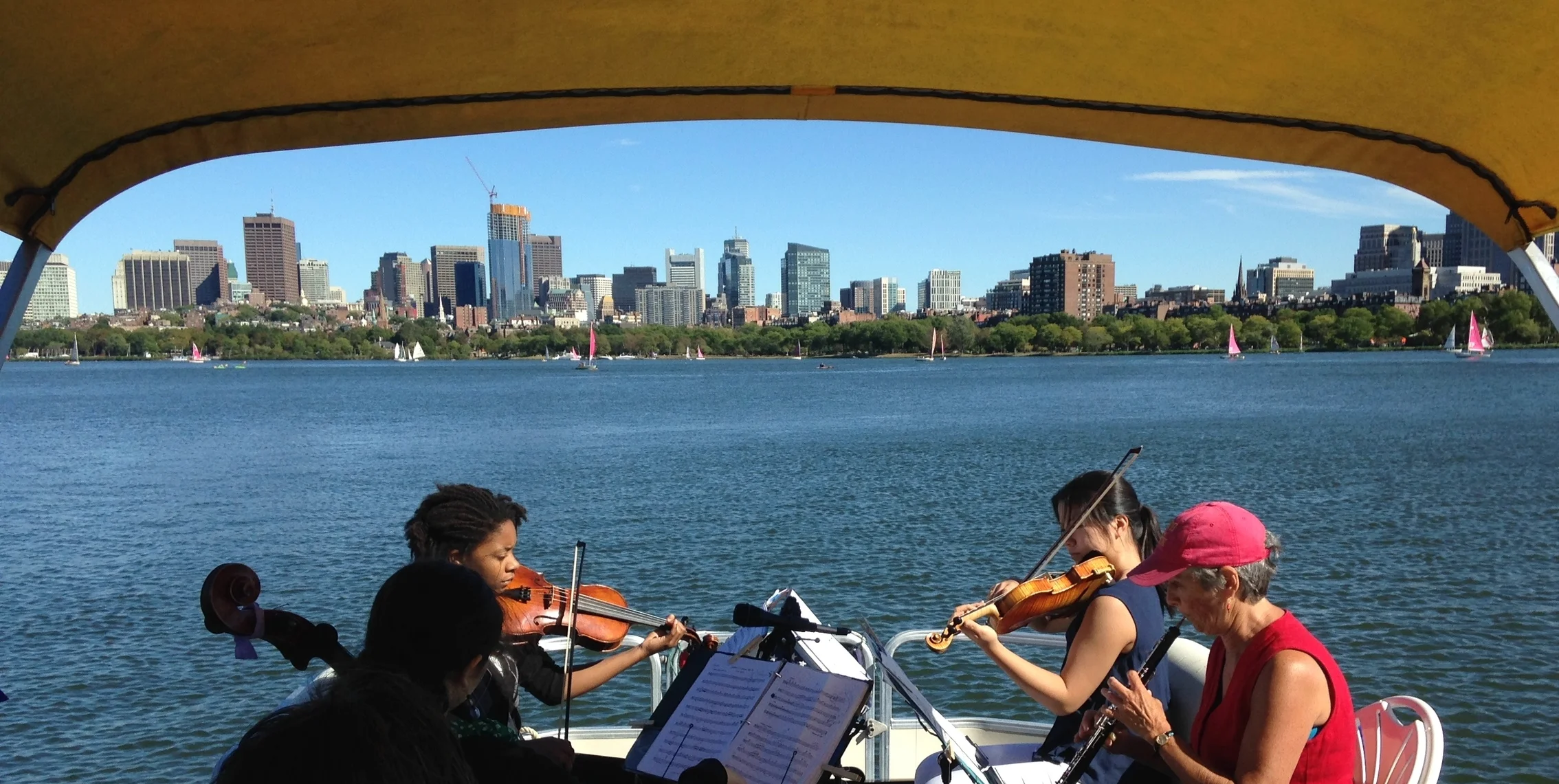
Chamber on the Charles
Did you miss our concert on the Charles River Basin with Violobos and Captain Benjamin Zander? If so, never fear — you can re-live the journey with our slideshow!
Did you miss our concert on the Charles River Basin with Violobos and Captain Benjamin Zander? If so, never fear — you can re-live the journey with our slideshow!

Megan Henderson's Many Songs for the Spirit
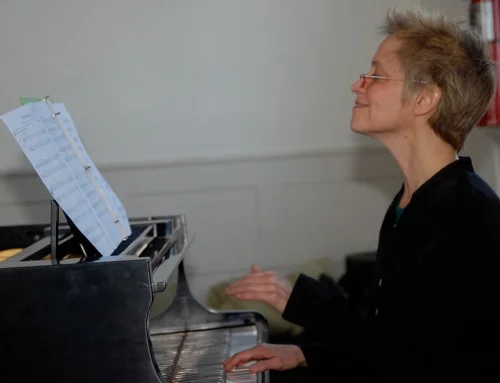
Many of you know and love Megan Henderson from her work as a pianist with Winsor Music's concert series and outreach program. We're so pleased to introduce her to you anew as a composer of our newest Song for the Spirit (although anyone involved in the Boston-area Shape Note community has known this side of her work for many years)! We discussed her history of writing music in (and bending the rules of) the Shape Note tradition, how she navigates between many musical traditions and practices, and why, for her, every song looks to the Spirit.
Many of you know and love Megan Henderson from her work as a pianist with Winsor Music's concert series and outreach program. We're so pleased to introduce her to you anew as a composer (although anyone involved in the Boston-area Shape Note community has known this side of her work for many years)! She has composed a new Song for the Spirit, "With Grace We Meet our Trials" or "Jewell Hill" for our concert on October 4, where she will be sharing the program with her former conservatory professor, John Heiss, as well as music of Boccherini and Schumann.
Megan Henderson is a graduate of the New England Conservatory and has been the adult music director at Payson Park Church since 2010, serving as organist and adult choir director. Megan is a member of the Schola Cantorum of Boston and has made numerous recordings with the Boston Camerata. In addition, she is also active as a pianist and piano teacher in the Boston area. She is on the staff of the Harvard Summer and Extension schools and Village Harmony Summer Camp. She has traveled and performed as a singer throughout the UK and Northern Europe with Northern Harmony, a group that specializes in World Folk Music.
What started the process of writing this Song for the Spirit?
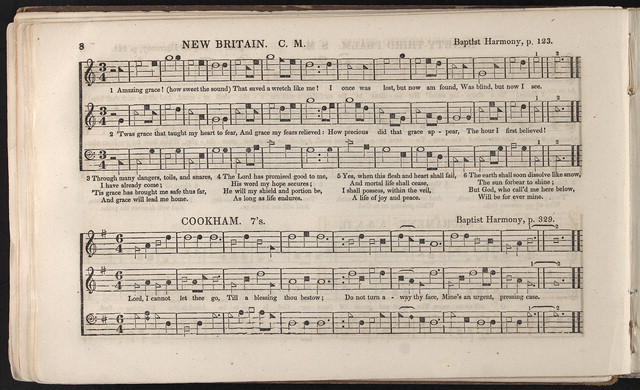
I’ve been interested in Shape Note music for a long, long time, and have been experimenting with the various forms. One predominant form is known as the fuguing tune, which is where you have a homophonic first section, and then a miniature "fugue" to follow.
Can you explain what a fuguing tune is?
It’s not the traditional fugue that Bach would have written, but it does involve the voice parts entering one at a time with the theme or a variant of the theme.
So something like a canon?
Yes! Something like a canon, but canons are the exact same theme coming in at different times.
And where does the text come from?
The words for the fuguing part of this tune come from John Leland, who composed the text for a song called “Ecstasy,” which is in the Sacred Harp [collection of shape note songs], but it seems that his words were loosely based on Psalm 55. I wanted to change the surrounding text of Leland’s chorus, so I composed my own words for the A section to reflect my beliefs about the spirit.
As far as I understand, that’s fairly common to modern-day Shape Note singing, that it’s not necessarily tied to religious observance, practice or belief, but that the singers map their own beliefs or philosophies onto the hymns.
That’s interesting, I hadn’t thought of it that way. There is definitely a resurgence of composers writing in the shape note form. More often, people are using pre-existing texts but getting experimental with the harmonies and the meters.
And are you getting experimental with harmonies?
A bit, yes! I also mess around with the meters from time to time as well.
Have you composed much before this that you’ve released publicly? Personally, I’ve seen things that you’ve written, but have you published or offered your work up for performance?
Well, yes. Most of what I’ve written has been performed by various groups under the Village Harmony umbrella. I’ve been writing in this style for many years now, in this short form. I did write one larger scale called “The Police Log” which is based on the crimes that are listed in the newspaper in Hancock, New Hampshire. The Police Log in Hancock cites such heinous things as a dog digging up somebody’s garden, nothing much more serious than that. That project (commissioned by Jody Simpson) was a lot of fun.
Is that available for public consumption?
I could arrange for that to happen, actually, yes. I also have a piece called "Gordon" that just came out on a new recording by a wonderful group called the Starry Mountain Singers. My pieces are scattered around the internet here and there and on various recordings.
Do you remember the first piece you composed? When did that happen?
Yeah, it was in 1991, when I had broken my wrist — I’m a pianist by training, so the broken wrist put a damper on things, so to speak. I’d been singing Shape Note music for about two years and had gone on a few of trips to England, singing with a group from Vermont that did mostly Shape Note music. I was really fascinated by this style of music, and since I couldn’t play, I decided, alright, I’m going to try to do a little writing. When I first started that in 1991, about six pieces came out right away. They were all based on texts that I really loved and tried to set in my own way with my own style. I’d never written before that. It was surprising to me to find how intrigued I was by the writing process.
How did you get involved with Shape Note singing?
I was singing a concert with my Schola Cantorum in Stratford, Vermont, and a friend in the group had another friend in Vermont who was very involved in the Shape Note community, named Larry Gordon. Larry came to the concert and he and I hit it off and started doing Early Music projects together. Then he introduced me to Shape Note music and I’ve been involved with it ever since then.
There seems to be a link between Shape Note music and Early Music - there are some famous examples of cross-over recordings and performances by Early Music groups. Why do you think that people who are drawn to Early Music have such a draw to Shape Note as well? What is the connection there?
There are similarities in the stark harmonies for starters. Whatever your beliefs are, the spirituality in both of those forms of music is visceral and seems to deeply affect people whether they have a spiritual practice or not. Then there is the “fuguing” aspect, which is connected to the contrapuntal music which you find a lot in Renaissance music. The Boston Camerata and Anonymous Four are good examples of groups that have delved into both genres. I sang on some Shape Note recordings also with the Boston Camerata, and their approach is a little more polished than what my friends in Vermont tend to do in terms of performance practice.
Right; that’s another thing I wanted to ask you about. You are a (very) classically trained musician and pianist, and we at Winsor primarily know you through that kind of work. Shape Note has a very distinct vocal style which is not what a lot of people would consider “classical,” so I am wondering what it’s like for you to move between those two styles, especially as a singer. I know you also sing with Schola Cantorum of Boston and other vocal groups.
I thought you’d never ask! What instantly drew me about Shape Note music was the raw power and energy it has. Having had conservatory training, I was thrilled to see how uninhibited one could be in singing music. When I first started singing Shape Note music with people in Vermont, many of them were [musically] illiterate, but sang with such spirit and such heart; that was what really excited me about that kind of music. There’s not much similarity between singing Thomas Tallis and singing Jeremiah Ingalls, for instance… there’s a lot more chest voice in Shape Note singing and what they like to call the “hard-edged sound,” but in terms of the way I’ve been writing Shape Note music, I don’t tend to write pieces that are meant to be sung at the top of one’s lungs.
That answers my next question, which is: given that this Song for the Spirit is an audience participation portion of the program, and we are not going to be in the traditional square*, how do you intend this piece to be sung? How has our layout of the audience facing the musicians influenced your approach to writing a Shape Note piece?
I also am straying from the original Shape Note form in that, traditionally, Shape Note has the soprano and tenor line doubled up and down the octave. Mine is not meant to be sung that way. It’s really written in standard SATB form, so that’s how we’re going to sing it. The other way that I’m expanding my take on Shape Note music is by putting the melody in the alto line. As an alto myself, this is blatantly selfish! The alto line was usually written last in shape note music and was always by far the most boring line. I'm trying to correct to make that up to my fellow altos! I do also think there's a richness that comes with the melody in a lower register though. It’s probably more fair to say that this piece is written in the Shape Note style, rather than the Shape Note tradition, because of the text that I borrowed from the Shape Note “oevre” and the fuguing tune at the end. But I actually have been questioned: “Why are you even calling it Shape Note music?"
I would just like to point out that the neglect of the alto line is not only true of Shape Note music, that’s also true of traditional hymnody and results in the same problem. We altos are the filler!
Right! I want an interesting alto line, and hopefully with this piece, each line is interesting. I think that’s another real similarity between really intriguing Shape Note pieces and Renaissance music... every line stands beautifully on its own.
Well, not to repeat the question, but you’ve said that the fuguing device is Shape Note, the words are Shape Note, but other than that — because we won’t be in a square*, because we won’t be using that particular vocal technique, because the four part writing is distinctive — what about the piece makes it a “Shape Note piece” as opposed to a piece that uses Shape Note elements?
Visually, the audience will see that it is written in the traditional shapes. Also, the homophonic opening and the "fugue" that follows qualify the piece for that genre. The spiritual nature of the text is also standard fare for the Shape Note style.
So the spirituality of the song is what defines it as Shape Note, because Shape Note is so clearly spiritual?
Writing music, and writing in this style, has been my way of trying to express my own spirituality, which is why I chose to write the text for the first half of this song. I am trying to find ways to secularize spirituality, which I think is appropriate for our time. A lot of people are seeking spiritual direction and nourishment. This is not an easy planet!
What I really wanted to explore in this song was the issue of trust, and hopefully that will be reflected in the text. I was trying to find a way to express my connection to something bigger than myself in a way that more people could relate to. I’m a church musician, and it’s a fact that religious institutions are struggling to keep their membership up. For me, I think it’s so important to live with some sort of spiritual connection. I find it a lot in nature and have set texts in praise of the natural world. I am interested in trying to find and nurture what keeps us strong and gets us out of bed every day...being kind to other people, doing the best we can do here and at the same time sometimes longing for wings to "fly away and be at rest." I think most of us are just trying to live out our highest ideal of what it is to be human here on earth and somehow integrating spirituality into the fabric of our every-day existence.
I think that’s what Peggy was getting at when she created this project.
Perfect! I was first introduced to A Song of Peace (Finlandia) on the Winsor Music series, and now I use that hymn all the time with my church choir. Songs For The Spirit has a ripple effect; Music is one of the very best ways to spread the message of peace and and all of the other goodies we crave.
It sounds like you’ve got quite a bit of work out there! Can we hope for some sort of collected, easily accessible body of what you’ve written?
That’s what I’m hoping to do this year, actually, is get all of these shorter-form works into one handy book. It’s been fun over the decades to see how my writing process has changed - hopefully I’m getting a little better with each song.
Speaking of learning and improvement, you are programmed on this concert with one of your professors from the New England Conservatory! Can you talk a little about what that’s like?
To be on the same program as Professor Heiss is a great honor, because he was one of my very favorite teachers at the Conservatory. I studied Twentieth Century Music with him. He was an inspiring, invigorating, and refreshing teacher... brilliant, articulate, kind and very approachable. He made a difficult kind of music that initially seemed intimidating very accessible. He piqued my interest in twentieth century music to the point where I started writing some of my own!
*The “square” referenced here is the traditional seating arrangement for Shape Note singing. A square is constructed using one or more concentric rows of chairs in which all singers are seated, including during performance. One singer traditionally stands in the center of the square to call the next song and lead it by keeping time, very simply in two beats, by raising and lowering their hand and forearm. The square is central to the distinctive sound of Shape Note because there is a dramatic acoustic difference between being a participant, sitting in the square, and an observer, standing well outside of the square. One cannot really attend a traditional “sing” as a removed observer in the way that classical audiences do because one cannot really hear the music unless one is in the square; even the word used to refer to occasions of Shape Note music-making is indicative of this complete breakdown between audience and musician. There are no performances, there are only “sings.”

An Interview with Mitsuru Yonezaki, violin
Mitsuru Yonezaki is our featured young artist for the first concert of our 2015-16 season, and a founding member of Winsor Music's first mentoring ensemble, Violobos! She began her violin studies at the age of four and currently studies with Joanna Kurkowicz. She took time out of her busy schedule to speak with us about how she has embraced chamber music, how singers and wind players like Peggy inspire her, and how music fits into her present and future.
Mitsuru Yonezaki is our featured young artist for the first concert of our 2015-16 season, and a founding member of Winsor Music's first mentoring ensemble, Violobos! She began her violin studies at the age of four and currently studies with Joanna Kurkowicz. Having enrolled at the New England Conservatory Preparatory School under Fudeko Takahashi (2004-2013), she has become the youngest member of many orchestras, including their top orchestra, the Youth Philharmonic Orchestra, at age 11. She has been selected as the winner of various competitions including NEC Prep School’s competitions (category B - 2nd, 2013), the Kobe International Competition (2011, Grand Prize and Special Award for Artistic Excellence), and Newton’s Classical Idol Competition (January 2010). Mitsuru is currently a member of the Boston Philharmonic Youth Orchestra, led by Maestro Benjamin Zander, which toured the Czech Republic, Germany and Switzerland this past June to perform in 9 different halls, some of which include the Smetana Hall in Prague, Berliner Philharmonie in Berlin, and Kultur und Kongresszentrum in Luzern.
When Mitsuru is not practicing or at school, she enjoys cooking, reading, and spending time with her friends sight-reading music. She took time out of her busy schedule to speak with us about how she has embraced chamber music, how singers and wind players like Peggy inspire her, and how music fits into her present and future.
You are a rising junior in high school?
Sort of - I’m also completing my senior year now. I’m taking the courses that I need to graduate.
So you’re going to be done at the end of this year?
Yes.
What’s the plan after that?
Hopefully going to a music school.
It says in your bio that you’ve been playing the violin since you were four years old. How did you start?
My sister, who also plays the violin, was my inspiration - I frequently went with her to her lessons, watched her practice, and it kind of made me curious about music, so I also started the violin.

Photo credit: Kendra Colton
Did you ask for lessons when you were four?
Yes, I did.
Why did you stick with it? A lot kids start, but not a lot of kids get to the point that you’re at now.
I just really liked all of the repertoire I had to explore. I was doing orchestral and solo music, and some duets with my sister, and I think there’s still so much to learn, both musically and repertoire-wise. I just really enjoyed making music. — You never got bored. — Yes.
Did you imagine or hope when you were younger that music would be such a huge part of your life now?
I guess to a certain extent, I expected myself to keep working with it, but I wasn’t sure how it would turn out. At first it was more of a thing that I liked to do, but now it’s a huge part of my life.
Do you remember the first chamber group that you participated in? What did you play? What was the experience like?
Yes, I do. My first real chamber group was the summer of 2012 at camp, that was when I was first exposed to it. I remember playing Mendelssohn Op. 44, No. 3, 2nd movement. Everyone else in the group had been at the camp for a while, so they were helping me through the process. They made a big impression on me, concerning chamber music. They made everything about rehearsal seem so fun and interesting, even when it was the tedious things that you have to work through, they would make it fun. Having different people lead, exchanging the parts. Everything about it became really fun.

If your first chamber group was in 2012, how many years had you been playing violin prior to that experience?
Around nine years.
That’s a lot of experience as a violinist before you ever got into a chamber setting. Was it a shift for you? When you say they were helping you work through the process, what did you have to work through as you were making that adjustment?
I had to learn how to really listen for other people, and respond to and interact with what they were giving me. Because I was playing second violin, I had to make sure that I wasn’t playing second violin underneath; it has to be equally as strong as the first violin. I think that was a different experience; sometimes the first violin feels more like the soloist in an orchestra. To play second violin was to support the group but also sometimes have these moments where you shine out. That was a different idea that I sometimes now use in my solo playing as well to vary phrases, when I want to be more intimate or reserved, that second violin instinct kicks in and helps me do that.
You had been playing in orchestras before you started playing chamber music. How old were you when you started playing in orchestras?
I began at the NEC String Training Orchestra when I was five, and I first got into an orchestra with winds and brass when I was six.
So you have been in orchestras for as long as you’ve been playing. When you were making that adjustment to chamber music, were you adjusting from being a soloist, or adjusting from being an orchestral player, or a little bit of both?
It was a little bit of both, because in the orchestra, you have your whole section to play with you, so you try to play with each other. In that sense, playing with each other [in a chamber group] wasn’t that big of a change from the orchestra, but in the sense that you’re the only one on the part, it was an adjustment, so I think it was a mixture of being a soloist and in an orchestra. I was finally coming to the middle of those two extremes, of being part of a group and being the only one.
I know you spent part of your summer on tour with the BPYO, and part of your summer at the Perlman Music Program, an intensive music camp. Can you tell me about both of those experiences?
For the tour, we got to experience different cultures and different foods, which I really liked. All of these places that we performed at and visited gave me more insight into the composers’ mind. We visited some Jewish museums, which gave me some ideas around some European Jewish composers. Playing at these great halls was just… it was mind-blowing that we were all there. We also got to listen to the Berlin Philharmonic. I happened to have a seat that was behind the timpanist for that concert, so I was watching the conductor and observing how people from that angle were interacting with each other and with the conductor. It gave me some ideas as to how I could change as an orchestral musician. I was mainly observing the principal stands to learn more about leading and how they do it. I thought it was incredible that they would give small cues, but because they were slightly turned in, everyone would see that and do the same. That was one of the things I learned there: even the smallest gesture can make a big difference if you let show to others.
At camp [the Perlman Music Program], because I was one of the older campers there, who had been there longer, I got to experience being a kind of mentor to some of them. There were some people new to chamber music, so it was like my first summer but the roles were reversed. I got to help with the rehearsal process - giving ideas on how we wanted to phrase things. Because we also do singing at camp, that gave me different ideas, because when you sing you have to breathe. When I play violin, I don’t need to take breaks, so by singing, it helped me. During practice, I would sing a little to figure out where I needed to take “breaths” or make a phrase.
So singing is a part of the core curriculum at your camp? What kind of repertoire were you doing?
It’s choral repertoire, some Schubert, Handel, and a piece by Gyorgy Orban in Latin about the devil. It was very intense and in a different style from the beautiful tunes by the other composers. I think they intended for us to have a variety. They said that singing could give you new ideas about how to phrase, and thinking about breathing.

Photo credit: Kendra Colton
Along those lines, what has it been like for you, in your experiences with Violobos, to work so closely with a wind player/instrument? I know it’s not necessarily something that other young string players experience. Has it affected you in any way?
Playing with a wind instrument, especially the oboe, has changed my playing because when I’m playing with another violinist, we both know how loud and soft we can play. With wind players, it’s a different kind of range. It’s probably easier for the strings to adjust to the wind player, and the breathing comes in again. I’m still working on blending to [Peggy’s] sound, but I think I’m getting better.
As a string player, what is involved when you’re working to blend with Peggy (or anyone, for that matter)?
I mainly listen. Because the oboe has a more naturally — I don’t know what the right word is — angular? — sound, I try to focus on my contact point. I also try to take cues from the way that she breathes. If she takes a slower breath, I feel like it’s supposed to be a warmer sound.
When you talk about your bow placement in regards to her more angular sound, are you trying to match her sound or complement it?
Sometimes I try to match her sound, especially when we’re playing similar rhythms to each other. When I’m playing, for example, a counter-melody or the bass line, I try to complement it so that her voice comes out more than mine.
What are you most looking forward to about this concert?
It’s a different group of people, I’m excited to be working with these people. I recognized one name - the cellist, Rafael Popper-Keizer — because I know him as the principal of the Boston Philharmonic. I’m looking forward to working with these people who are much more experienced than me. I also like working with people my own age, but learning from the more experienced players is always fun.
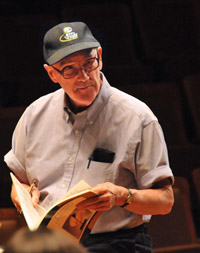
Composer John Heiss
Is there a piece that stands out to you at this stage of preparation?
I’m excited about Mr. Heiss’ piece because I’ve heard of him, as a living composer. Some of the ways that he wrote reminded me of Schoenberg, so I’ve been trying to compare other contemporary works with this piece, and it’s been really fun.
What role has music played in your life so far? Is it a supplement to your other activities or is everything else a supplement to music, or is there a balance?
I think music is a balance for me. It helps me in my academics, but then there is the math in music, so academics comes into music. It goes both ways, but I see music as my main focus.
Is it too soon to ask what your plans are for the future? You mentioned that conservatory is on the horizon.
I am going to try to pursue a career in music performance. I want to go to conservatory or any school with a teacher that I would love to work with. I want to make my music unique to me and figure out how to present myself as an individual and make sure my technique is well-polished.

Announcing: the Hatchfund Campaign for our Mentoring Program
We are officially launching our Mentoring Program campaign on Hatchfund, a non-profit crowd-funding website dedicated exclusively to supporting art and artists like us. I am happy to say that with the support of donors like you, we have already raised $1600, or an astounding 40% of our target goal!
Dear Friends,
We are excited to share our latest news with you: today, September 1, we are officially launching our Mentoring Program campaign on Hatchfund, a non-profit crowd-funding website dedicated exclusively to supporting art and artists like us. I am happy to say that with the support of donors like you, we have already raised $1600, or an astounding 40% of our target goal! Now we need your help to reach our “stretch goal” of $6,000 by September 30 so we can expand our mentoring program for the coming year.
In Winsor Music’s Mentoring Program, high school students and a professional mentor play together in a small chamber music group. Last January, we started our first mentoring ensemble, Violobos, with Alma Bitran, Njioma Grevious, Mitsuru Yonezaki and myself. This ensemble rehearses 2 hours every two weeks over the course of the academic year. The ensemble also performs for the Boston community in Winsor Music’s outreach concerts, as well as on our chamber series alongside professional soloists and ensembles. This season, we are formalizing and expanding the program to include more students, and violinist Gabriela Diaz will lead the next ensemble.

The money raised through this campaign will be used as a stipend to fairly compensate our mentor Gabby for her time and commitment to the program and her students. All donations are tax-deductible. Any surplus raised over the original goal will be used to fund the mentoring project in future years. We’re offering some great rewards for your donation, like VIP attendance at a closed dress rehearsal or even a house concert!
Please check out our project page here: http://www.hatchfund.org/project/mentoring_program and don’t hesitate to reach out to us if you have any questions about the program, the campaign, or anything else.
Thank you so much, as always, for your support of Winsor Music. You have told us, and we agree, that the future of our organization is in educating and supporting the next generation of musicians and music lovers. We love this work, and we are so grateful that you help us to do it.
Open Auditions for the Bach Institute!
It’s hard to believe, but this is the fifth year that the Bach Institute, a collaboration between Emmanuel Music, Winsor Music, and Oberlin College, has been in operation! Exciting enough that it’s our fifth anniversary, but even more exciting is the fact that we are holding competitive auditions for the first time this year!
It’s hard to believe, but this is the fifth year that the Bach Institute, a collaboration between Emmanuel Music, Winsor Music, and Oberlin College, has been in operation! Exciting enough that it’s our fifth anniversary, but even more exciting is the fact that we are holding competitive auditions for the first time this year!

The Bach Institute is now open to college students, graduate students and young professionals from all over the world. There are openings for: soprano, mezzo-soprano, tenor, baritone/bass-baritone, violin, oboe, flute, cello, and keyboard. (Keyboard players should know or expect to learn figured bass.) If you or someone you know is interested in applying, please visit our web page, which has all of the information you could ask for and an online application and audition form. Singers are asked to provide an mp3 of any Bach aria in German, and instrumentalists must submit a single mp3 containing both a fast and slow movement of any instrumental Bach work. Applications are due by October 7, 2015.

All of the collaborators on the Bach Institute are incredibly proud of this program. It provides students and young professionals with the opportunity to explore and perform Bach cantata arias. For nearly three weeks in January, students participate in the weekly cantatas at Emmanuel Church, study Bach cantata arias and perform them on outreach concerts in Boston and the surrounding area. The culmination of the Bach Institute is a public concert at Emmanuel Church.
Please share with your friends, colleagues, and students: winsormusic.org/bachinstitute, and email bachinstitute@emmanuelmusic.org with any questions you might have.

What's in our toolbox? CoSchedule!
Guess what, everyone? We just hit 500 likes on Facebook last week, something we’ve been working on all year! We've been using a tool that we really love and we wanted to share it with you.
Guess what, everyone? We just hit 500 likes on Facebook last week, something we’ve been working on all year! At least when we had the time… when we remembered to think about it… Maintaining our blog and social media profiles is a lot on top of our day to day work as a three-person staff, but we know it's the best way to keep in touch with all of you. We've got plenty of ideas but not a lot of time, so we figured we needed a good tool to pull it all together.
This summer, I asked our intern Tricia to research some social media management tools. She presented me with a few well-known names, but told me right away that her favorite was CoSchedule because their application has a drag and drop calendar. (She’s been paying attention! I think drag-and-drop calendars are great for flexibility and adaptive planning.)
CoSchedule is more than a calendar, more than a posting queue, and more than a spreadsheet. It’s a comprehensive editorial calendar that allows you to plan blog posts, schedule social posts, communicate with your team, assign tasks, and get a birds’ eye view of it all. We’ve only been using it for a few weeks, but it’s changed our approach to content, social networking, and our digital presence.
We have a three-person staff, but we know we need to make the time for content marketing and social media. One of the time-saving features I love about CoSchedule is the notes function. When I stumble across a link that I want to post, I throw it onto my CoSchedule calendar as a note. Later on, I turn it into a full-fledged social post, usually when I’m doing my planning for the next few weeks. If I want to move the post or the note because something more relevant comes up, all I have to do is drag and drop.

As far as blogging goes, you can use CoSchedule solely as an editorial calendar. If you’re on a WordPress website (we’re not — Squarespace all the way!) you can connect your blog to CoSchedule and write your content within the CoSchedule interface, or work with CoSchedule’s great social integrations in WordPress. If you use another content management platform like we do, there's a simple workaround. You can connect CoSchedule to services like Google Docs or Evernote and easily export your content in multiple formats. Meanwhile, you're keeping track of tasks, comments, and social media related to that blog post in CoSchedule.
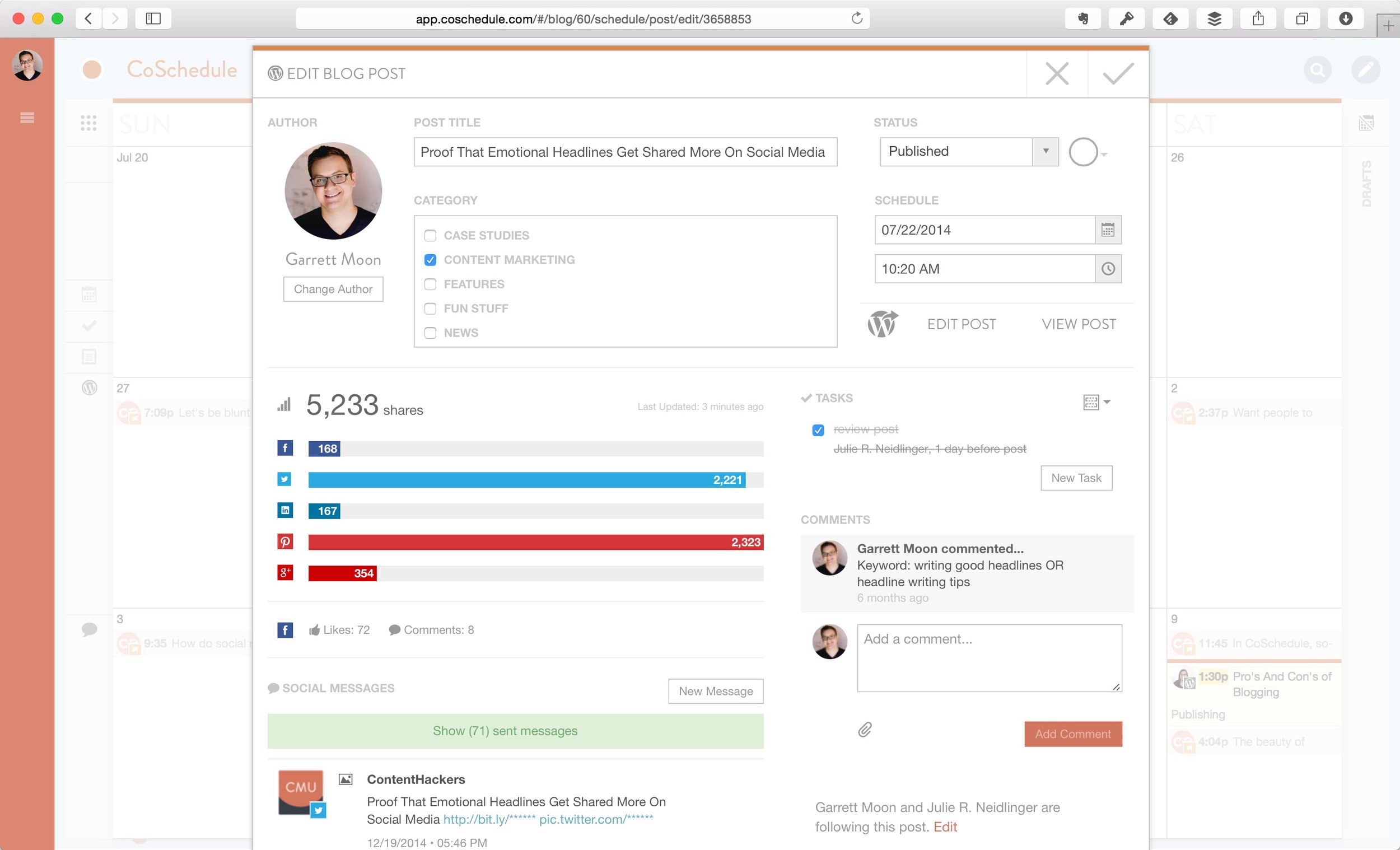
I have a Google Alert set up for several of our organization’s key interests and mission topics. J.S. Bach is a particularly lively one! I glance over those results as they come into my inbox, and if any are useful, I put them on the CoSchedule calendar as a note. I try to generate at least one piece of content daily from within CoSchedule. After that, I’ll spend fifteen minutes a day scrolling through our peer organizations to share their posts. Audiences seem to respond well when we cross-promote!
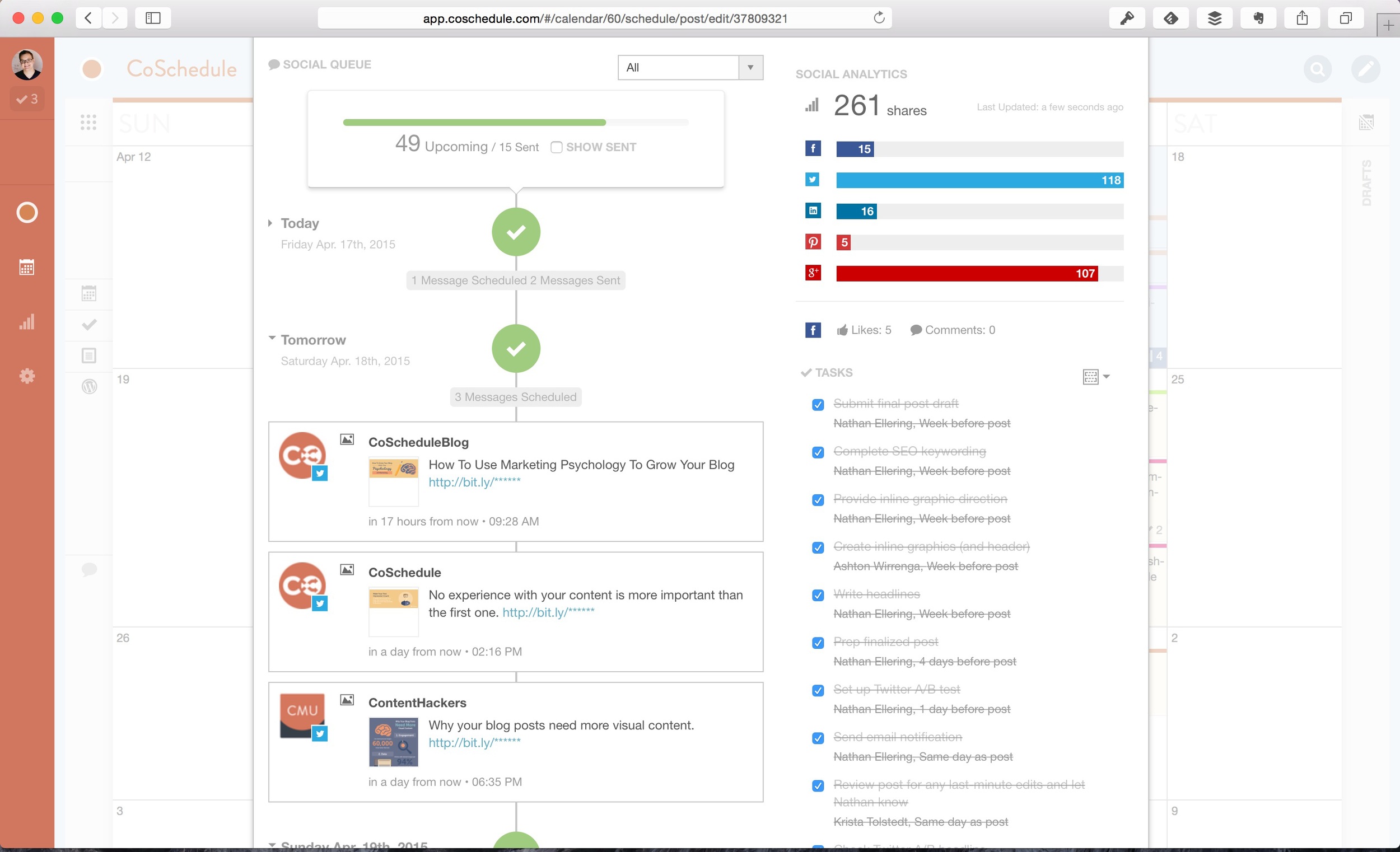
CoSchedule integrates with most social media networks, Bit.ly, Google Calendar, and Buffer. There’s a 14-day free trial, and the subscription costs are certainly cheaper than hiring another staff member. Their customer service is helpful and responsive. I’ve been in touch with them several times and they've always given a great response.
If you want to try a free trial, use our referral link (here and above) and please reach out to me if you have any questions. They also have great content and free tools on their website that anyone can use and make good use of, whether they’re a CoSchedule user or not. I encourage you to check them out, and please do reach out if you have any questions. And if you like it, make sure to thank Tricia!

New Music, New Pathways: An Interview with James Baker
For the last two weeks, our Artistic Director Peggy Pearson has been at the Wellesley Composer’s Conference, one of the oldest and most prestigious conferences of its kind. James Baker is Music Director and Conductor of the Composers Conference at Wellesley College, and he very graciously took some time out of his jam-packed schedule this week to speak with us about his love of new music, his work at the conference, and his unique vantage point as a percussionist, conductor, and composer of electronic music.

For the last two weeks, our Artistic Director Peggy Pearson has been working with and performing the new works of ten composition fellows at the Wellesley Composer’s Conference, one of the oldest and most prestigious conferences of its kind. Guided for nearly 40 years by Pulitzer Prize-winning composer Mario Davidovsky, the Composers Conference & Chamber Music Workshops offer participants a unique two-fold experience. First, it provides a select number of emerging composers with an intense two-week program of seminars, public colloquia, and performances of their recent works. It also provides talented amateur chamber musicians with a stimulating workshop environment that includes coachings by nationally-renowned faculty, opportunities to attend masterclasses, concerts, and much more. The final concert will take place this Saturday, August 2nd at 8pm, in Houghton Chapel on the Wellesley College Campus (click here for directions and here for the complete program).
James Baker is Music Director and Conductor of the Composers Conference at Wellesley College, Director of the Percussion Ensemble at the Mannes College of Music, and Principal Percussionist of the New York City Ballet Orchestra. Mr. Baker was the Conductor of the New York New Music Ensemble and is Principal Conductor of the Talea Ensemble. As instrumentalist or conductor he has premiered music by many of the great composers of the 20th and 21st centuries including: Boulez, Cage, Carter, Messiaen, Dillon, Harvey, Wourinen, Davidovsky, Glass, Aperghis, Reich, Reynolds, Henze, Crumb, Babbitt, Neuwirth, Furrer, Billone, Fernyhough and many, many others, often working closely with the composers. Through his work with his groups, at conferences, universities and festivals, he is an advocate for the music of a whole new generation of composers from around the world, premiering hundreds of new works over the course of his career. He very graciously took some time out of his jam-packed schedule at the Composers Conference this week to speak with us about his love of new music, his work at the conference, and his unique vantage point as a percussionist, conductor, and composer of electronic music.
What do you most look forward to at the Composers’ Conference every year?
I think the two things I look forward to most are: one, getting together with the amazing ensemble of musicians that we have here. The ensemble of twenty-seven players is an amazing group of people. I really look forward to working with them; they’re incredibly talented, incredibly giving, and generous with their time, both in rehearsal and in preparation; they’re very well prepared. Two, it’s very important for me to spend as much time as possible with Mario Davidovsky, and I look forward to being able to see him on a daily basis. In New York, we see each other often, but not daily, and it’s really great to be here with him. He’s one of the great masters and one of the really important people in my life, and I really love him, so it’s always a pleasure to be able to see him every day and talk to him about philosophy, music, architecture, religion, and a wide range of subjects on which he is an absolute authority. Those are the two things that I most look forward to.
How did you become involved with the Composers’ Conference?

Mario Davidovsky, Composer and Conference Director
I was invited by Mario around seven years ago. The previous music director here, Efrain Guigui, was here for many, many years with Mario, and they basically established the paradigm that exists here, and were really responsible for how this place runs, and the ethos under which it operates. So Guigui was taken ill, and Mario just called me and asked me if I would want to substitute for Guigui for the summer, and I said sure. I had heard from a lot of people who came up here to play — I’d never come up here as a player myself — I had played and conducted a lot of Mario’s music in New York, so he knew me and invited me. Just before I arrived here, Maestro Guigui passed away, so I did the first summer here, and then was invited back for a second summer. After that second summer, they offered me the job as music director, which I gladly took because it’s such a special place, and that’s how I got here.
What sets the Wellesley Composers’ Conference apart from others of its kind?
There are a couple of things. One is that there are a limited number of fellows — ten fellows —invited to write, and since there are only ten, they get a pretty good amount of attention from the musicians, from me, and from Mario, and the invited guest composers. We invite a distinguished guest every year to run the seminar with the composers. I also know from my contacts in the outside world who sit on panels adjudicating composers who have submitted their work for prizes — I hear that our recordings are some of the best that these young composers are submitting for adjudication. So not only are they getting personal attention, they get a very good performance. We provide them with a fully professional recording. We have a great recording engineer, Tony DiBartolo, he’s a super-great recording engineer, so the recordings are top-notch, and the performances are top-notch. Also, the fact that there are amateur participants here, the fact that it’s also a chamber music center sets us apart, as opposed to just a conference. So as well as a staff of unbelievably talented professional musicians and this group of [composition] fellows, we have a whole group of dedicated amateur players who just love to play. They come here every summer, they’re coached by the staff of professionals on traditional chamber music, and then my professional staff plays some traditional chamber music on every one of our concerts as well. So it’s a super mix of brand new and old, and a dedication to coaching the amateur players. There’s a very utopian atmosphere of professionals and amateurs getting together and working together and experiencing together as much as we can. It’s a really amazing place. At times, when it’s all clicking, the synergy is really fantastic. Everyone is co-existing musically, the coachings are going well, the pieces are going well, the records are going well, it can be just a fantastic experience.
What sparked your interest in new music and working with composers?
It goes back pretty far. When I was a young kid in high school, I started listening to a lot of jazz, I was playing a lot of jazz music. At that time, I was listening to progressive jazz, Herbie Hancock, Miles Davis, post-bebops, and then I started getting more into experimental jazz. At the same time, I had a teacher, I was was maybe fourteen or fifteen years old, and my percussion teacher also taught at Albany State University, so I used to go down there with him to take my percussion lessons and also to play in an ensemble there. At that time, there was an experimental studio for electronic music at Albany State. It was run by Joel Chadabe, and I think John Gibson was one of the guys that was there; these guys were doing some amazing, early experiments in electronic music. I used to just watch these guys wire stuff up and put things together, and I played in a couple of pieces were they were mixing live and electronic performances, and I was just completely fascinated by it. So I started getting really interested in new composition and new ideas about how to make music, and then at the same time I had a crazy record store in my town, a small town in upstate New York. When I would go to the record store to buy jazz records, all of a sudden I was finding these records by Elliott Carter and Pierre Boulez, and I didn’t really know who they were, but I started talking to my teacher about them, and he started telling me who they were, and I started listening to these records as a sixteen year old. That was it, it changed my life forever when I started hearing Boulez and Carter and Charles Wourinen and guys like that, I just knew that’s what I wanted to do. I’m really in love with classical music, and I still love jazz, but I’ve had a long love affair with living composers and contemporary music.
With that background, it seems like you’re a great fit for the Composers Conference and Chamber Music Center!
I learn a lot, especially from the staff players; they’re so giving. I’ve been working with many of these people for most of my life, I learn a tremendous amount from them, and they’ve been very helpful in making me a better musician, no question.
Have you tried your hand at composition yourself?

I write music, I do. I don’t write as much as I make music. I make electronic music. I write things out that need to be performed by live players that I will then transform electronically. I have written things for live musicians and electronics, but these days I’m writing mostly electronics. I write a lot of music for dance. I’ve been commissioned by the NextWave festival at BAM, the Abbey Theatre in Dublin, I’ve had stuff performed all over the world, as relates to music for dance. It’s not something I advertise. I don’t consider myself to be the level of composer that we get here. I’d be completely mortified to play any of my music for Mario; I want him to love me! If he listened to any of my music, he wouldn’t love me anymore. It’s not that I’m ashamed of it; I’m like any composer in some ways, although I’m not as diligent. My work comes and goes. I just do a big chunk and then I won’t do it for a long time. I don’t consider myself a composer in that way, sitting down at a desk every day and working out issues. I like electronic music and I like experimenting with ways to produce it.
And I’m sure that it influences your work with the composers and musicians who are writing and performing this new music; your work must give you some insights into what they’re doing.
Yeah, it does, certainly. There are a lot of conductors who are not necessarily composer-friendly, and they can make the process very difficult because they can get angry about a lot of things that I would never get angry about. I really love composers and I give them a lot of leeway because I know how hard it is, and I give the players a lot of leeway because I know how hard it is to play! I’m always striving for the most collaborative process possible. I like to surround myself with people that are equal collaborators.
That’s a nice transition into my next question. You have the perspective from your composition work when working with composers, and as a very active performing musician you have that perspective when working with the musicians, so how did you transition into conducting from percussion?
I started a long time ago. In high school, I had a music teacher in high school, not one of my private instrumental teachers, but a choral director, a very smart, sensitive musician named Wesley Sandberg. He took a real interest in me, tried to cultivate my talents and encourage me as much as possible. He said to me one day: “You should conduct some stuff!” I said okay, so I started out conducting some choral pieces, and I was bitten by the bug back then, and then as I went away to music school, I started conducting lots of ensemble pieces that I put together myself. I never studied conducting. I went to school to study playing, but I conducted a lot, because I loved new music and I was trying to do as much as possible. There wasn’t always so much offered by the school, especially at Juilliard. We really had to make our own way, because there was not a lot of contemporary music at Juilliard at the time when I was there. It was post-Luciano Berio; when he was there, he had an ensemble and they did a lot more, but when he left, the whole contemporary music scene there went sour. It was a pretty conservative place. So I had a lot of opportunities to conduct there, just putting stuff together. I just segued into it because I liked contemporary music and I just wanted to do it. I had some desire, it’s hard to identify what those desires are when you’re young, but there was something in me… I just felt like waving my arms! And then people pointed out to me later, you know, you have a lot of the required skills for this sort of thing: I could hear well, I could move my arms well from being a percussionist, all of those tactile parts of it were not that hard for me. I’ve always been fascinated by the idea of music, of harmony and counterpoint and pitch… I’m really fascinated by that stuff, and the organization of music. It’s a great way to be an organizer, being a conductor. I still love playing and I still play all the time, it’s kind of a split life. I would never turn my back on playing, I really love it, and I love being with other players, playing chamber music, playing in the orchestra, too, it’s all really great.

Facsimile of Le marteau sans maître by Pierre Boulez, available for purchase at Schott Music (click to view)
What piece of new music has had the most impact on your life/outlook/career?
That’s a hard one. One would probably be the Boulez Le marteau sans maître; when I first heard that piece down at the record store, I think it was the old recording by Robert Craft. I was just blown away by that. That, and there was a Stockhausen score of Gruppen when I was in high school. I used to play in an orchestra at Williams College, in Williams, MA, right across the border from my home town — I grew up in Troy, New York — I used to drive across and play, and I had time off I’d go to the Williams College library, and they had all of these scores there, and I remember looking at Gruppen and thinking “Wow.” That blew my mind too. Those two pieces really did it. There was something about the European avant garde… it was weird, I discovered the post-war European avant garde, then the American movement, it was kind of backwards. And how that happened to me in a backwater town in New York State, that I would be drawn into post-World War II European music as my first real love for new music… don’t ask me, it’s crazy. I don’t know how that happened.
A touch of fate?
Perhaps. That’s my earliest consciousness of something changing how I thought about music, those two pieces.
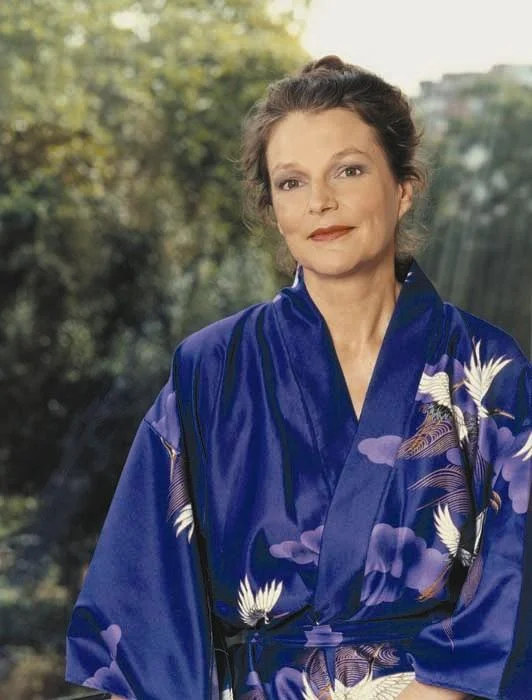
Peggy Pearson and John Harbison Pay Tribute to Lorraine Hunt Lieberson
We absolutely love this interview: it's a chance to hear John Harbison and Peggy Pearson in conversation, a masterclass on the hard work and intentional craft of singing, an insightful analysis of Cantata 170, and a beautiful and thoughtful tribute to Lorraine, both as a musician and a person.
We absolutely love this interview: it's a chance to hear John Harbison and Peggy Pearson in conversation, a masterclass on the hard work and intentional craft of singing, an insightful analysis of Cantata 170, and a beautiful and thoughtful tribute to Lorraine, both as a musician and a person. Many thanks to Brian McCreath, the Bach Hour, and 99.5 WCRB for hosting, producing, and sharing this with us!
You can hear the full Bach Hour show, and the full performance of Cantata 170 on their website.
Don't miss this: Peggy and John Harbison on The Bach Hour
This Sunday, July 12, host Brian McCreath interviews oboist Peggy Pearson and composer John Harbison on WCRB’s The Bach Hour about Lorraine Hunt Lieberson and her performance of Cantata 170 on the recording we released last fall.
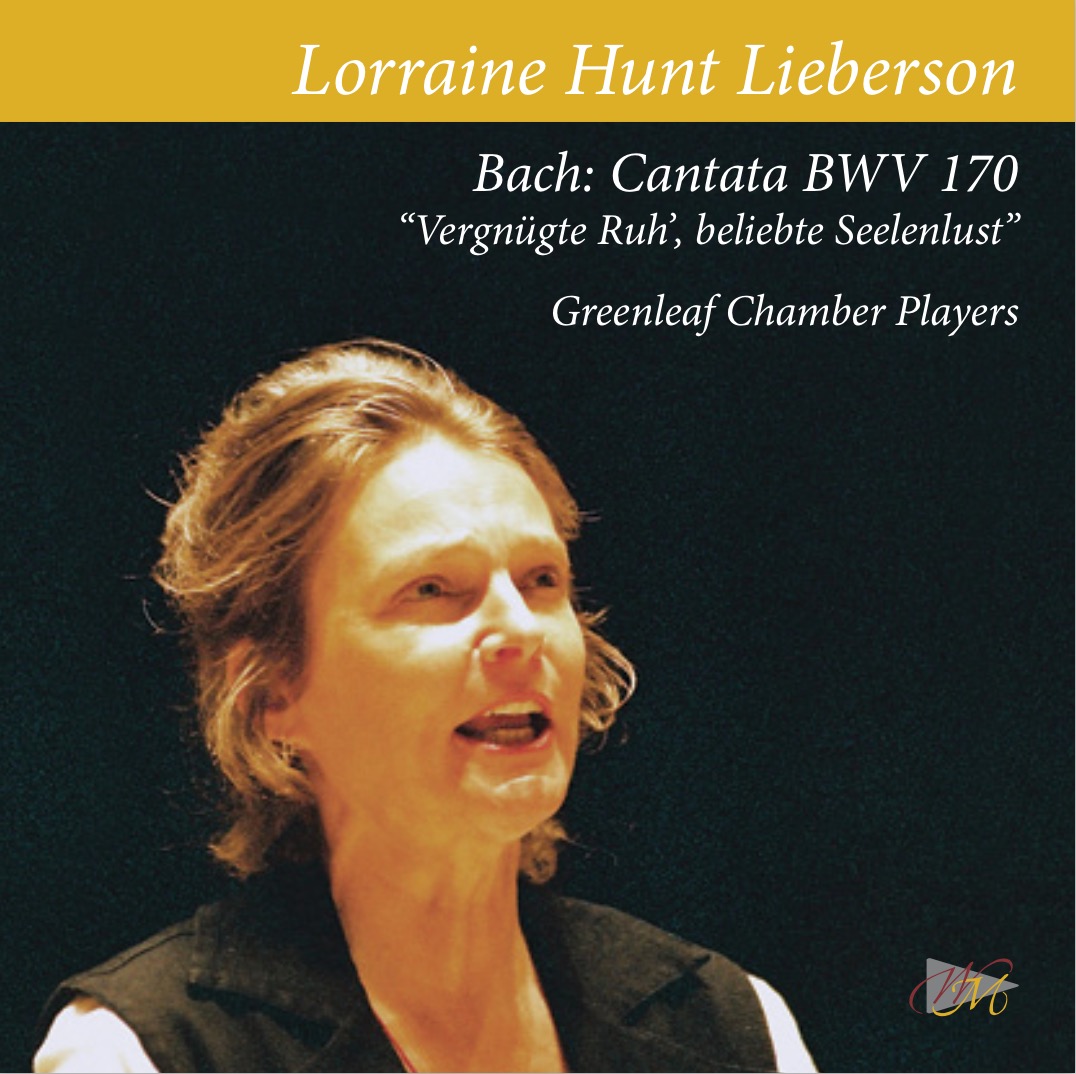
This Sunday, July 12, host Brian McCreath interviews oboist Peggy Pearson and composer John Harbison on WCRB’s The Bach Hour about Lorraine Hunt Lieberson and her performance of Cantata 170 on the recording we released last fall.
For those of you not familiar with The Bach Hour, here’s a description from WCRB’s website : “The Bach Hour grows out of a tradition begun in the early 1970's by Robert J. Lurtsema of WGBH 89.7 FM. As one of the earliest sets of the complete Bach cantatas on record (Leonhardt and Harnoncourt) was being released, they became a regular fixture on each Sunday's edition of Morning Pro Musica, Lurtsema's unique daily program. Now, on The Bach Hour, those cantatas, with the rich and diverse range of performances now available, are heard on the calendar days for which they were written. Combined with recent and classic recordings of Bach's instrumental masterpieces and occasional interviews with significant interpreters, each week's program offers a chance to connect more deeply with this bedrock composer.”
John, Peggy, and Brian discuss Lorraine’s talent, her start as an instrumentalist, her devotion to Bach, what an extremely hard worker she was, and the unique blend of focus and exuberance that so defined her performances. This is a rare chance to hear this cantata on the calendar day for which it was written (the sixth Sunday after Trinity), performed by an outstanding group of musicians, and with sensitive and expert commentary by John Harbison, a top Bach scholar and Peggy Pearson, who, according to Richard Dyer of the Boston Globe, "has probably played more Bach than any other oboist of her generation; this is music she plays in a state of eloquent grace.”
Tune in to WCRB 99.5 FM Sunday morning at 6am or visit our website later that day for a link to the program. In the meantime, you can revisit Peggy’s blog post about her memories of Lorraine, or get your copy of the recording here - included on two “Best of Classical Music” lists for 2014. All proceeds from the sale of the recording go to Winsor Music’s education programs.
Save the Date!
Get your calendars, friends! Winsor Music is excited to share with you a sneak peak of our upcoming 2015-16 season calendar.
Get your calendars, friends! Winsor Music is excited to share with you a sneak peak of our upcoming 2015-16 season calendar.
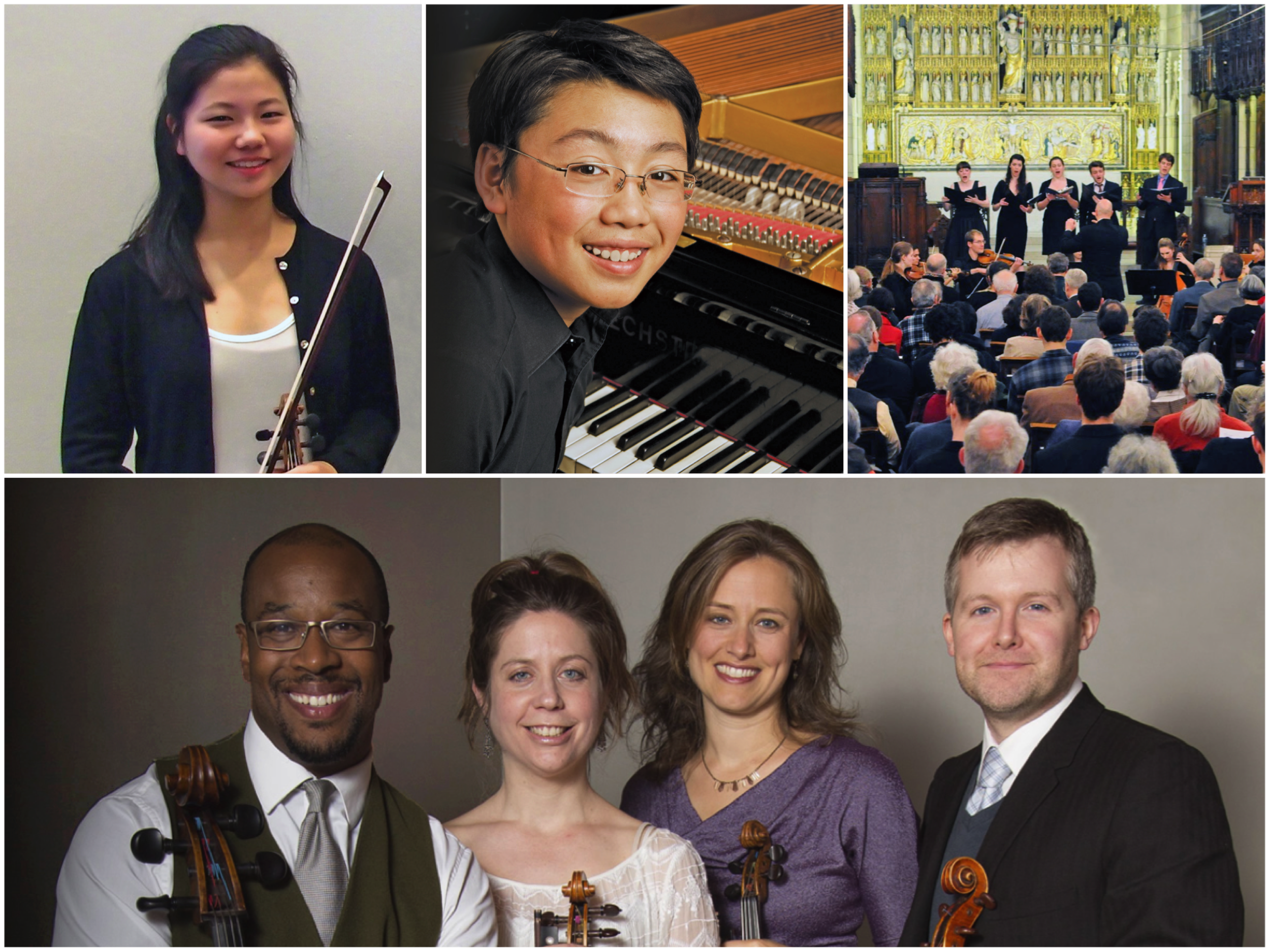
Chamber Series I – Young Artist: Mitsuru Yonezaki, violin
October 4, 2015 at 7:00 pm
St. Paul’s Church, Brookline
This fall we will be featuring two amazing young artists in our concerts. Our first concert will feature Misturu Yonezaki. She is a member of Winsor Music's mentoring ensemble, Violobos and with her other quartet members, just returned from the Boston Philharmonic Youth Orchestra's summer European tour.
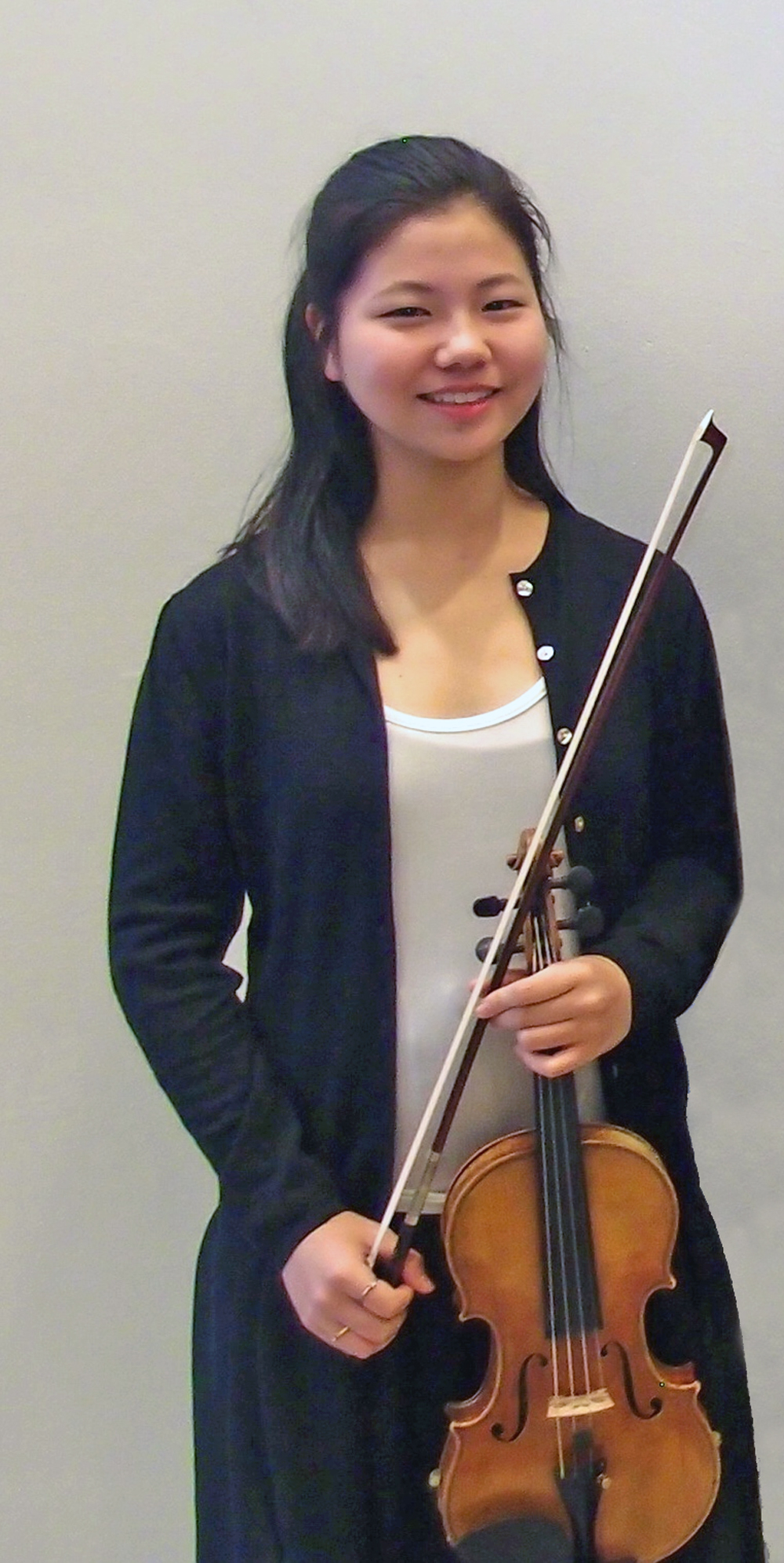
Chamber Series II – Young Artist: George Li, piano
November 29, 2015 at 7:00 pm
St. Paul’s Church, Brookline
The following month, George Li will join us for the second concert of the season. He played with us during last year's season and is a Winsor Music favorite. George also recently placed second in the prestigious Tchaikovsky Competition.
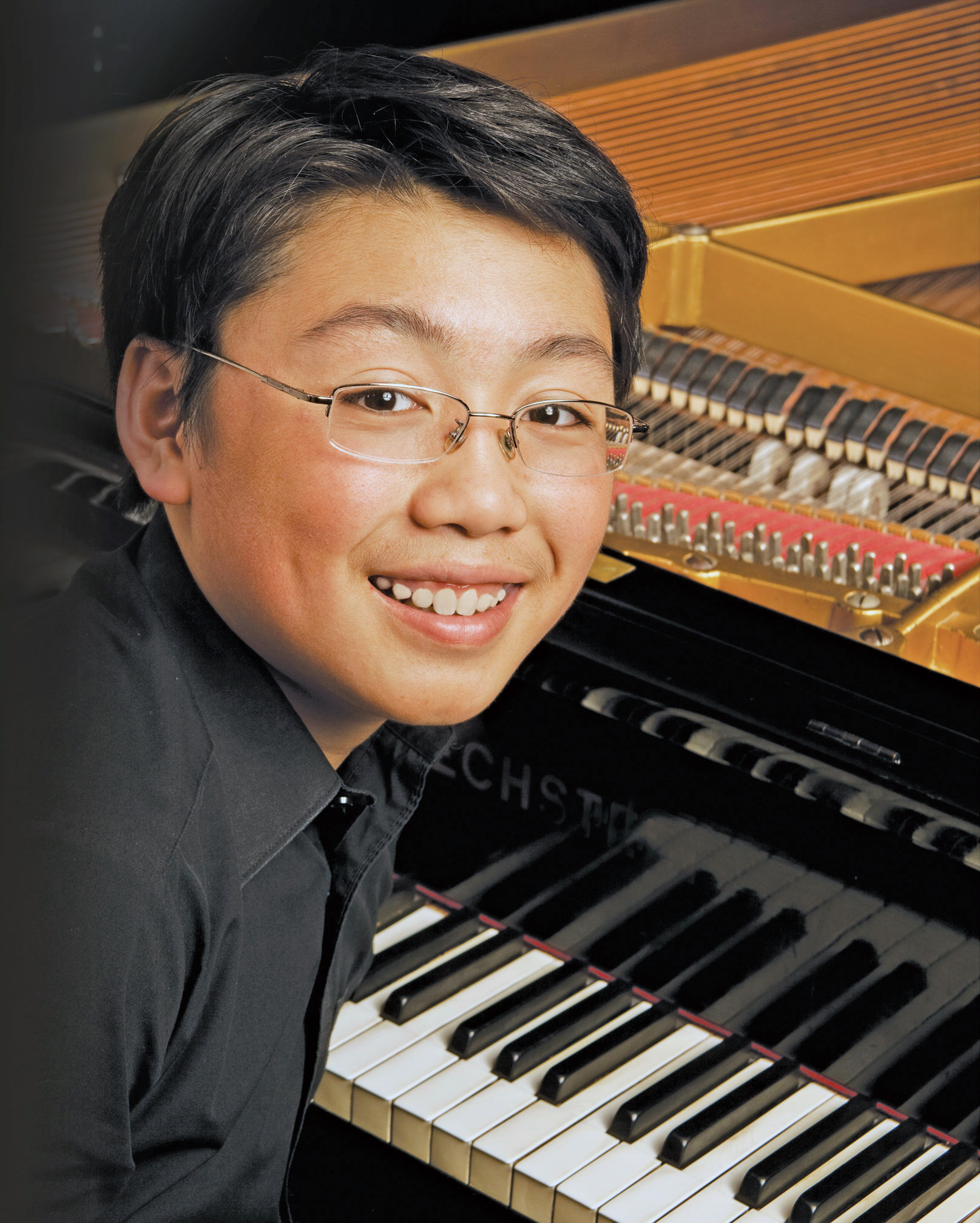
The Bach Institute – Final Concert – 5th Year!
January 24, 2016 at 7:00 pm (Snow date, Jan. 25)
Emmanuel Church, Boston
In January, we will again be partnering with Emmanuel Music and Oberlin College to present the Bach Institute. This is the Bach Institute's fifth year, and we are excited to give more students the opportunity to explore and perform Bach arias.
Chamber Series III – To be announced
At the moment, we can't share any details about Concert III, but we can guarantee that it will feature more of the musicians and music you love.

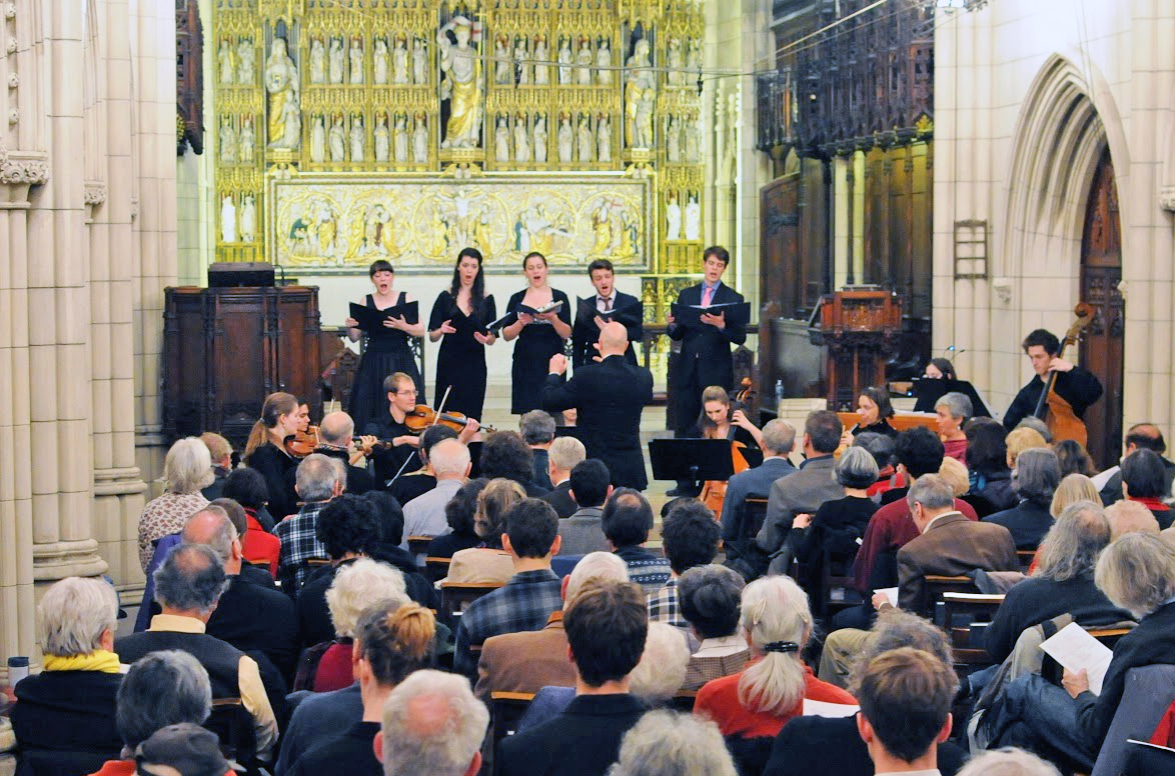
Chamber Series IV – Apple Hill Quartet
April 24, 2016 at 7:00 pm
St. Paul’s Church, Brookline
Rounding out the season, the Apple Hill Quartet will join us again for Concert IV in April. For our out-of-town fans, there will also be concerts in Newburyport, MA and Peterborough, NH – more information on these dates soon!
Keep a look out for more announcements! We'll have more details to share about Concert III, music selections, composers, and ticket information soon.
Don't forget to save the dates!
Welcome, Tricia and Sarah!
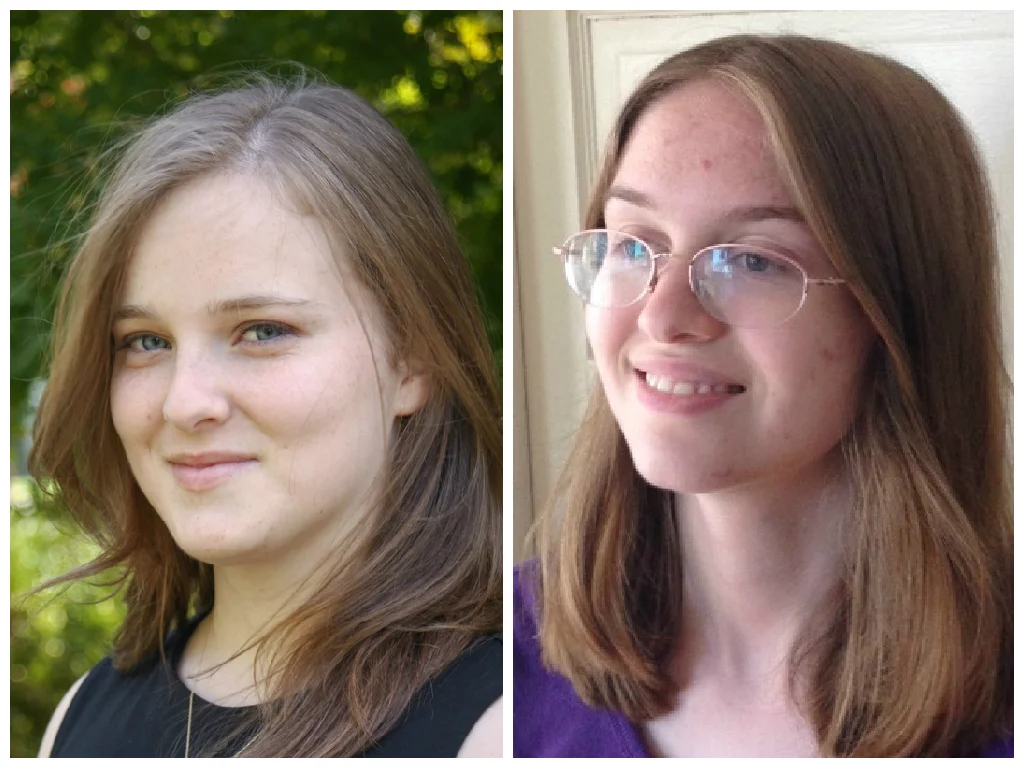
Happy summer, friends! We're delighted to welcome to new interns to Winsor Music this summer, both from Smith College in Northampton, MA. Meet Tricia Kopko and Sarah Netsky!
Happy summer, friends! We're delighted to welcome two new interns to Winsor Music this summer, both from Smith College in Northampton, MA. Meet Tricia Kopko and Sarah Netsky!
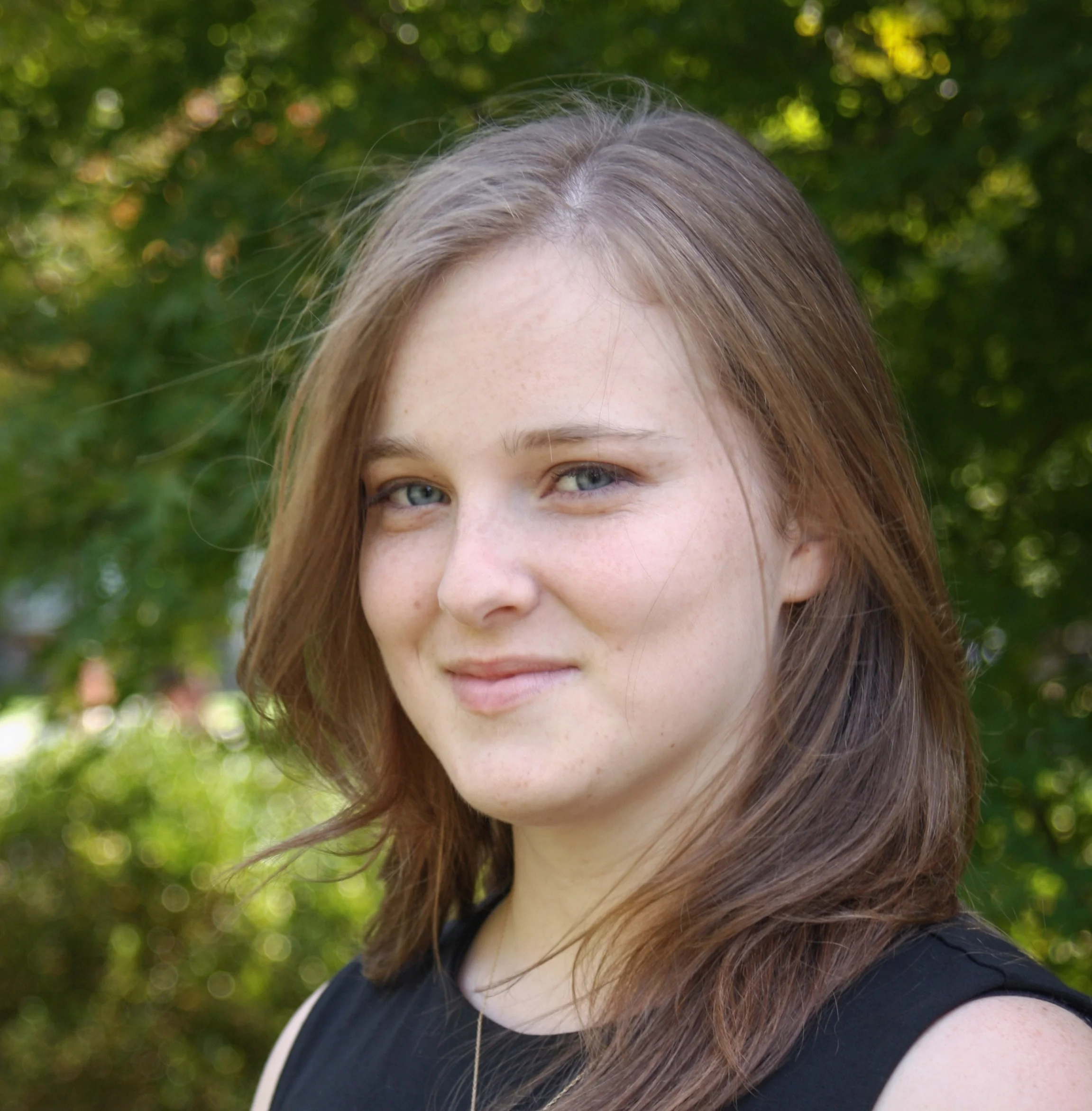
Soprano Patricia Kopko recently graduated from Smith College with degrees in Chemistry and Music. At Smith, she was a member of the Glee Club, the Chamber Singers, and the Handbell Choir. Last summer, she studied traditional Korean music at Ewha Womans University in Seoul, South Korea. Patricia is the 2015 winner of the Smith College Concerto Competition, and earlier this year she played Joy in Ronald Perera’s one-act opera The Araboolies of Liberty Street. Patricia is excited to join Winsor Music this summer as an intern and intends to pursue a career in arts administration and vocal performance.

Sarah Netsky is very excited to be interning at Winsor Music this summer. She was born and raised in Cambridge, MA, and throughout her life, she has had a consistent passion for music, both listening to it and performing it. She has studied piano with Catherine Lawlor at the New School of Music in Cambridge and with Liza Stepanova at Smith College. She has also played clarinet in the Smith College Wind Ensemble. She is currently pursuing an Italian Studies major and an Archives Concentration at Smith, and has just finished her sophomore year. She will spend her junior year studying in Florence, Italy, with the Smith program there.
An Interview with the Apple Hill String Quartet
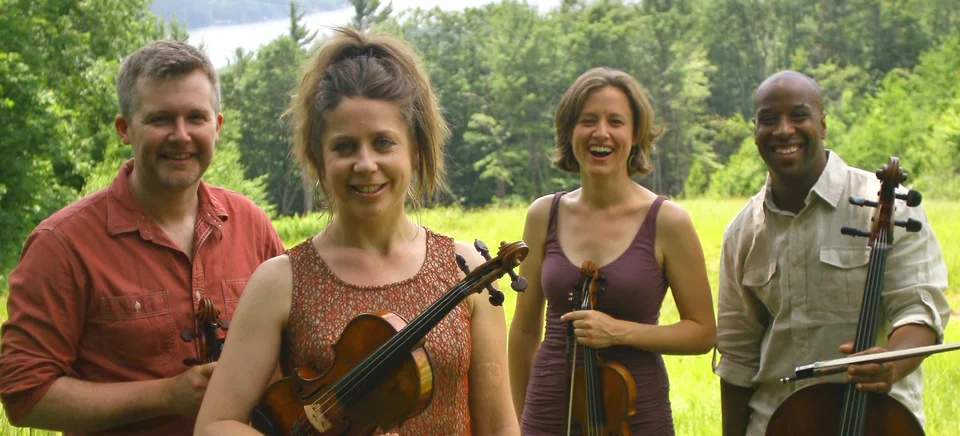
Winsor Music is delighted to welcome the musicians of the Apple Hill Quartet — Elise Kuder and Colleen Jennings, violin; Mike Kelley, viola; and Rupert Johnson, cello — to the Concert Series. They spoke with us before the first of three concerts with Peggy Pearson; the third concert will take place at St. Paul's Church in Brookline on Sunday, April 26th at 7:00pm.
Since its founding in 2007, the Apple Hill String Quartet has earned praise around the world for its concerts presenting interpretive mastery of traditional repertoire – including Haydn, Mozart, Schubert, Schumann, Beethoven, and Ravel – as well as for world premieres and commissioned pieces. As resident musicians at the Apple Hill Center for Chamber Music, the Quartet is featured in the summer concert series held every Tuesday night at the Center in Nelson, N.H. These concerts attract hundreds of visitors and have become a mainstay of the Monadnock area summer music offerings.
Winsor Music is delighted to welcome the musicians of the Quartet — Elise Kuder and Colleen Jennings, violin; Mike Kelley, viola; and Rupert Johnson, cello — to the Concert Series. They spoke with us before the first of three concerts with Peggy Pearson; the third concert will take place at St. Paul's Church in Brookline on Sunday, April 26th at 7:00pm. Tickets can be purchased in advance at a discount here.
What brought you together as a group?
Mike Kelley: Apple Hill as an organization has been around since the early ‘70s. Elise and I were both students there in the ‘80s at the summer camp. As the previous generation retired, we got brought on to be part of the resident ensemble. Rupert was actually a last-minute replacement to be a coach in the summertime. We went to school with Colleen at Oberlin: the small music world!
How did you get connected with Peggy and Winsor?
Elise Kuder: Lenny! Lenny and Apple Hill.
MK: Peggy was a coach at Apple Hill.
EK: When we were kids. Lenny and Peggy were at Emmanuel.
MK: And we also played at Emmanuel.
Did any of you coach with Peggy as kids?
EK: I coached with Moby [Peggy’s brother].
How do you adjust as a group when you’re working with guests like Peggy, or non-string instruments?
Rupert Johnson: Apple Hill is a place where we embrace folks from many different walks of life. So the concert of even adjusting- that’s just what we do at Apple Hill. Playing chamber music is the perfect way to get to know someone, and that someone can be playing a string instrument or not. The music requires that we come together and come to consensus on how we present this music. We find that music has a unique way of teaching us life lessons. Bringing in someone from the outside — we’re just sitting down with an old friend.
MK: And combining oboe with strings… Peggy makes it pretty. Peggy’s awesome.
EK: It’s really nice to get new perspectives. When you’re a group that works together a lot, of course you’re always trying to think of new things, and each piece brings a new perspective, but it’s always really nice to work with people who you don’t always work with, to get a fresh take on things.
What piece or pieces in your repertoire do you feel really represents you as a group?
MK: Part of our philosophy of programming is to have a new piece: either a commission or something that hasn’t been heard before; a piece that was written a while ago but isn’t heard enough: sort of a hidden gem; and an acknowledged masterpiece. This program is a good example of that, where the Haydn symphony is well known, but this is an arrangement for string quartet and oboe that was done by a contemporary of Haydn's that isn’t heard much, and a brand new work by Primosch that was written for Winsor Music, and then the Brahms, which is the apex of this repertoire for us. So this is a nice example of what we strive for as a group.
Colleen Jennings: Part of what we try to do when we travel is to discover pieces that might be relevant to the area where we’re going. So this summer, we learned a piece by a Turkish composer, Saygun, which was a complete novelty to all of us, and yet it defines us, because we’re one of the few groups that plays it, and has spent time getting to know it.
MK: And through Apple Hill’s Playing for Peace project, we go to the Middle East a lot. It’s funny, because the piece was new to us and everybody that we played it to in this country, but over there, it was like the Brahms is to us here; everybody knew it and knew him. That was really fun.
Could each of you pick out something in the Brahms that you really want the audience to share with you?
CJ: Something that’s coming to mind is the different textures. There’s a place in the first movement where you have a melody between the two violins that then becomes a melody between viola and violin. There are lots of places like that throughout the piece, but that stands out to me as something that the listener can grab on to. Brahms is so fun to play because the melodies are constantly bouncing from one instrument to the next and this also accounts for the many layers of texture.
EK: With the Brahms, there’s so much of this internal struggle, in a way, and it comes out in the different movements — sometimes a little more disturbed, and then sometimes the struggle alleviates or releases something. In the second movement, there’s such a beautiful tune in major that doesn’t seem like so much of a struggle, and the last movement is a total fiery release of that...
CJ: Or even the end of the first movement there’s all of this struggle and then there’s this giant push to the end.
EK: Yes. So I think just observing where all the push and pull, where all of the struggle and release is, and how does that make the audience member feel at the end?
MK: And in the same way, being at a live concert, seeing us play it and watching as well as listening: this is a place where he’s really experimenting with the different roles of the individual players. Like Elise said, at the beginning, there’s a place where we’re all playing together, but each one of us is doing their own thing, so we’re both in the same world and fighting for our own independence. It’s neat to see how that concept plays out in that movement but also throughout the whole piece.
EK: And the fighting is also sometimes negotiation or conversation, working out where the downbeats are, and playing off of each other. That’s true of Brahms more than most classical composers.
RJ: You’re in for a journey of searching constantly, throughout the whole piece. That’s a part of the Primosch as well; it has this searching quality throughout, and then when you get to the fifth movement, you’re searching and then you suddenly find something really joyful.
With the dialogue that you mentioned before, do you feel that you are four independent people or four parts of an internal struggle?
MK: You answer that question in different ways at different points in the piece. I think that’s a really fun thing about being able to be in the same room as the musicians playing it. You see us as four individuals playing our individual parts, but hopefully there are also these moments where it transcends that and becomes this one being, or other being, coming out of the center of the group. It’s fun to be dynamically in that with us.
Going back to the Primosch, Rupert, you mentioned that you find a journey in it?
RJ: Like the Brahms, but on a smaller scale — he chooses smaller movements to take you through this world, constantly trying to figure out where you are. There are moments where you feel like you’re completely at home. I find personally that he captures a very typical way of writing what might be parts of the American voices — a lot of jazz at the end that is obvious and tangible to listen to, and throughout, he’s constantly weaving many different emotions. That’s what my segue with the Brahms was about. Primosch has done it on a smaller level of time within the movements, but he’s created a huge world within a smaller space. To have this particular ensemble: the oboe, violin, viola and cello, it’s quite… orchestral, in a way. There are a lot of different flavors hitting you.
MK: I think he’s incredibly creative. He does an incredibly good job of writing music that is both really new and fresh and experimental sounding, and also really accessible, but never pandering to the audience. There’s a lot of drama, there’s a lot of humor, and then I feel like his writing, in terms of the colors that he gets… like Rupert said, it feels orchestral, but then it also feels like that period of time when they were suddenly adding marimbas and saxophones; the melding of a lot of different American styles. I think it’s amazing, the kind of colors that he gets in this piece, and as Rupert said, in such a short amount of time.
EK: I think the fast stuff and jazzy stuff might be easy to latch onto, and his slower, beautiful, moody music really gets you into a mood. I hope the audience enjoys the harmonies he uses and the voicing he does.
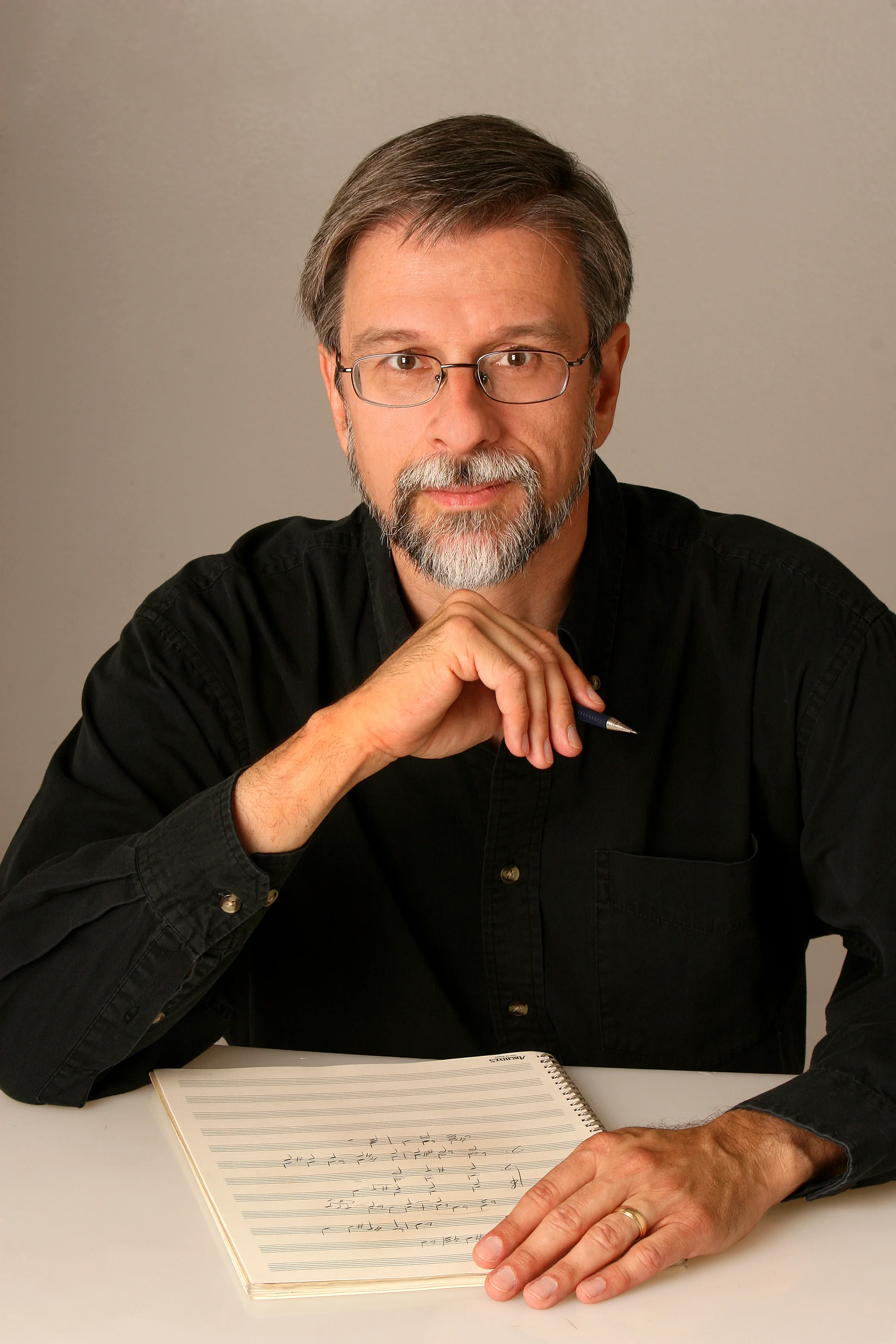
Meet Composer James Primosch
Prize-winning composer James Primosch has written a lyrical, lively, and wonderfully expressive oboe quartet for Peggy Pearson and Winsor Music, which will be performed by Peggy and members of the Apple Hill String Quartet at Winsor Music's final concert of the 2014-15 season. Read our interview to learn more about the new piece, how the composer arrived at his unique compositional voice and philosophy, and why he enjoys writing for Peggy and Winsor Music.
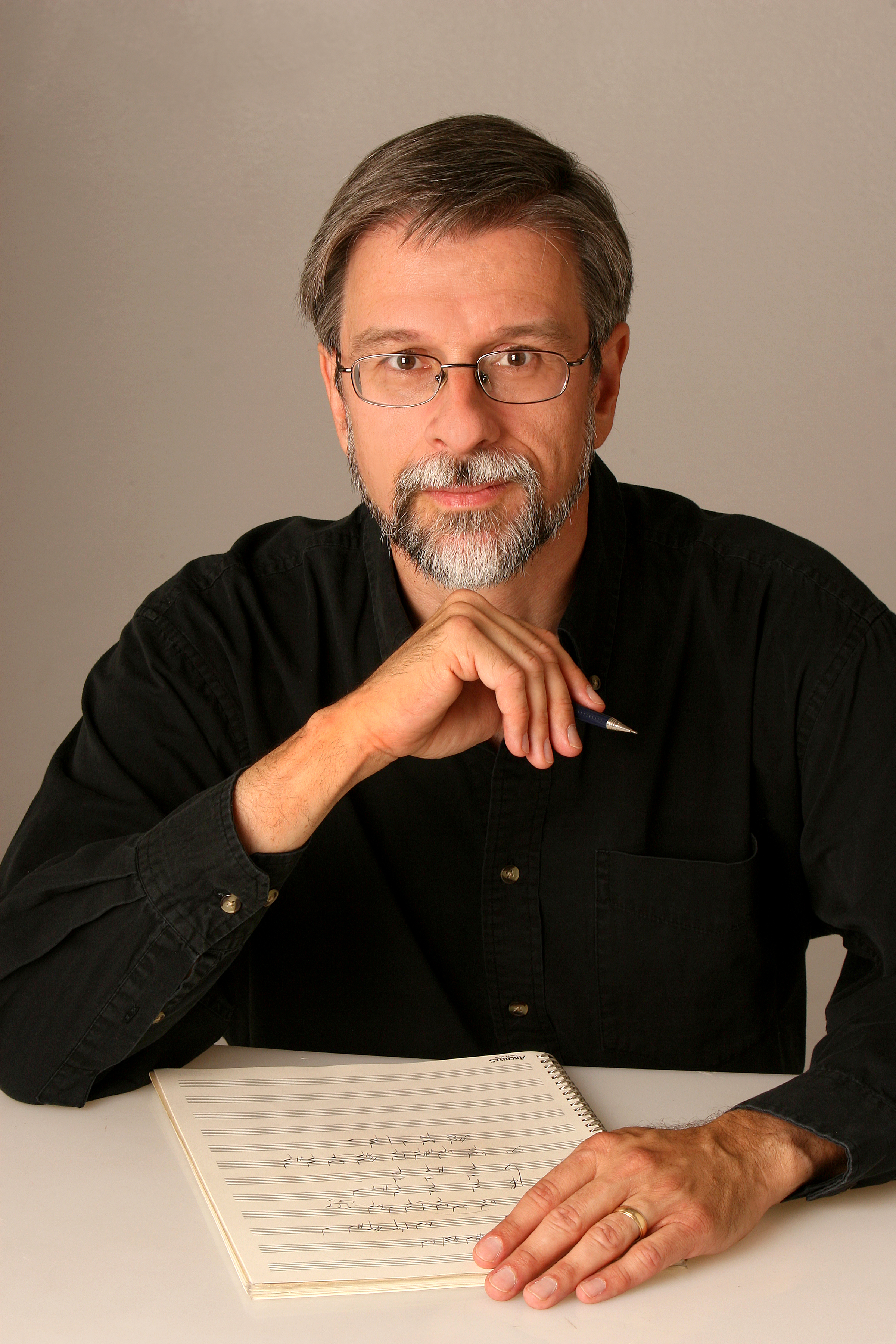
When honoring him with its Goddard Lieberson Fellowship, the American Academy of Arts and Letters noted that “A rare economy of means and a strain of religious mysticism distinguish the music of James Primosch… Through articulate, transparent textures, he creates a wide range of musical emotion.” Among the honors he has received are a grant from the National Endowment for the Arts, a Guggenheim Fellowship, three prizes from the American Academy-Institute of Arts and Letters, a Regional Artists Fellowship to the American Academy in Rome, a Pew Fellowship in the Arts, the Stoeger Prize of the Chamber Music Society of Lincoln Center, and a fellowship to the Tanglewood Music Center where he studied with John Harbison.
Mr. Primosch has written a lyrical, lively, and wonderfully expressive oboe quartet for Peggy Pearson and Winsor Music, which will be performed by Peggy and members of the Apple Hill String Quartet at Winsor Music's final concert of the 2014-15 season: Sunday, April 26 at 7pm, at St. Paul's Church in Brookline. Tickets can be obtained here.
Read our interview to learn more about the new piece, how the composer arrived at his unique compositional voice and philosophy, and why he enjoys writing for Peggy and Winsor Music.
Where are you from, and where are you based now?
Originally I’m from Cleveland, Ohio. I presently live and work in Philadelphia at the University of Pennsylvania.
How would you describe your music to someone who has never heard it?
Really, the music is diverse; it depends on the piece. There are some pieces that are very lyrical and other pieces that are more abstract or angular. The piece that I've written for Peggy is more on the lyrical side, although it does have its edges as well.
If you had to pick one piece that you’ve written that would encapsulate who you are as a composer, what would you pick?
If I had to pick one sound file I would email to someone, it would probably be of a song called “Cinder” which is from a set of songs for voice and piano called Holy the Firm [Click the link and scroll down to the fourth title on the audio samples page to hear this track]. It’s on a text by Susan Stewart, who’s a wonderful poet. This song seems to strike a chord with people. A number of singers have taken it up. In a very short time, I think it reflects my concern to try and do something that sings, that really has an intense, tightly lyrical line, that also has something fresh about it in the harmonic treatment, and is also emotionally touching. I would say all of those elements come into play in that two-and-a-half or three-minute song. That’s probably something I would call to people’s attention if I had to send out an mp3.
You started to talk a little about the piece that you’ve written for Winsor. Could you elaborate a little more, please?
It’s just called Oboe Quartet, and it’s in five movements. I first got to know Peggy, and her oboe playing, through Emmanuel Church/Emmanuel Music, so I was hearing the Bach cantatas with all of those fabulous oboe obbligato parts that she plays so beautifully. So, while my piece doesn’t sound Baroque at all, I don’t think, there’s basically a lyrical.. a singing conception more than a dramatic one — not that the cantatas aren’t dramatic, but I think of this piece as a set of songs or arias rather than a sonata or symphony kind of take. It’s dramatic, but it springs from a long line of vocal conception. The last movement is more of a dance than song, but that also is part of the Baroque tradition where the stylized dance is part of a multi-movement piece.

Photo by Emmanuel Church, Boston
Other than the elements you’ve just spoken of, what do you take into consideration when you’re writing for the oboe, or more specifically, for Peggy? Or for oboe quartet as opposed to a string quartet?
The oboe quartet as opposed to a string quartet: that was an interesting problem for me compositionally, because my first sketches — actually, some of my later sketches as well — it was kind of an oboe concertino. The tendency was to foreground the oboe rather than make it more of a chamber music quartet piece. I have a draft of the first movement where the oboe has the tune all the way through, which would have been lovely, but I revised some of that so the violin gets a portion of the tune at least once. So, yes, the obvious contrast of woodwind color and string color did lend itself to putting the oboe in the foreground, but I recognized that that was happening and I did try making more of a four-player game rather than having one hero in the spotlight. There are four relatively equal players now in what I’ve come up with. So, yes, oboe quartet was an interesting problem.
When it comes to Peggy’s playing: Peggy has greatly influenced what I’ve done with this piece, not only with her playing at Emmanuel, but also — this is the second piece I’ve written for her. Winsor Music did a collaboration with the Cantata Singers in commissioning this piece called Matins [Click the link to hear this track; it is the first piece listed on the page], and that featured the oboe; it had an introduction that is oboe and strings. Part of my reflection on the oboe was thinking about that piece and it required a little bit of effort to not rewrite that piece, because she did a really beautiful job with it, and there’s always the temptation to say, “Well, that worked! Do more of that!” But that’s a lazy thing to settle into too eagerly, although I think composers are kidding themselves if they think they’re getting a totally fresh conception all of the time. When you’re working on a piece, you think: “Oh yeah! I never thought of this before!” You think: “This is fresh, this is new,” and then you hear the piece, and you realize: “You know, I kind of re-wrote that older piece, didn’t I?” I certainly had that piece in the back of my mind.
Peggy has this gorgeous sound, such a beautiful tone, she just gets this amazingly beautiful sound on the oboe. She shapes phrases eloquently: so this means the variety of articulation and attack, how she’s able to connect musical gestures or set them off as the context requires, and then there’s also just virtuosity as far as her nimble fluidity and facility getting around the instrument. I really didn’t think about “Is this hard?” although Peggy might wish that I had! Of course I thought about whether it was practical or not, but it wasn’t a huge consideration, because I think she can do anything you could ask of an oboe, and do it beautifully.
Where do you see this piece in relation to your other work? It sounds, from what you’ve said and referenced already, as if this piece is thoroughly related to your other work. Do you have a body of quartets that this is being added to, or is this different in any way from the rest of your portfolio?
I have a couple of string quartets. I think those pieces are more narrowly focused in their expressive repertoire. The second quartet is a single-movement work, and it lives in the same expressive atmosphere for the entire movement. The third string quartet is also — well, there’s more variety there — but it’s more “of a piece.” This oboe quartet is a little more varied. If I had to relate it to pieces in my catalogue, it’s a little bit more on the eclectic side, a mixed grill, a little bit of this, a little bit of that; I think it still hangs together, I would hope. It all belongs in the same piece, and there is an expressive arc to it. The darkest movement is in the center, and in the first and the last movements, there is material that is recalled. I think it’s somewhat broad in its expressive range rather than so tightly focused.
You had made mention of this before; in that way, is it closer to some of your song cycles than to some of your quartets?
It is a little more like a song cycle, really in two ways. One is that there are a variety of expressive moods that are set, and also my cycles are definitely cycles, not just a set of songs, and there’s some sense of dramatic arc across these five movements.
I gathered from your website that sacred music is a central theme in your work, which you presumably were led to by your experience as a church musician and various compositional influences. Of course, classical music as we know it was developed and evolved through the patronage of the church, and most composers up to a certain point in time wrote sacred music because it was a natural part, if not the bread-winning part, of being a composer. However, it seems to me that at some point after the Enlightenment, there was a gradual shift towards art for art's sake, a general societal shift away from organized religion, and therefore a shift away from every composer necessarily being a composer of sacred music. I've heard other composers express transcendent aspirations in or influences on their work, but I think that you are the first composer that I have spoken with that is so explicit about being a composer of sacred music as well as a composer of "contemporary" or "new" classical music. Given the current compositional culture, do you feel that you have a foot in two different worlds, or has it been a uniform experience for you?
I’d approach the question from a couple of different angles. On principle, I would hesitate to endorse a separation of the sacred and the secular. For me, there is no such thing as the secular realm. It’s all about the sacred. Everything that is, is holy. Which is not to say that we can’t have any fun… I don’t mean a pious turning away from the world. It’s an embrace of the world in all its beauty and wonder, in a state of gratitude for the world. The other angle I would approach the question from is this: I was raised Catholic. I’ve worked as a church musician really from high school on, and practically speaking, there was no explicit connection between my faith, my practice, my work as a church musician… between those things and my concert music. A friend — a soprano — in the early 1990’s asked if I would do an arrangement of folk songs for a recital that she was giving, and I wasn’t into folk songs, but I thought about using old sacred melodies. I made her a set of what I called Three Sacred Songs. They’re arrangements of two plainchant melodies and a medieval carol. They’re all tunes I had learned in my work as a church musician in New York, so that was definitely a connection being made, or a hand being stretched across the gap. Not long after that, the second string quartet was a piece — in conception, an abstract instrumental piece — yet it’s kind of a meditation on the hymn “Let all mortal flesh keep silent.” That tune, and the motives of material that make it up, permeate the quartet.
So there was a kind of — breakthrough is a strong word — but I made an explicit connection between the sacred and the abstract. I’ve since done a lot of pieces where there are old sacred melodies more or less explicit in the piece and the other way that sacred connects is in the text. The cycle Holy the Firm — they’re not conventional biblical texts, although I have set biblical texts — they’re not highly orthodox, traditional religious texts, but they’re definitely concerned with the spiritual. They’re not inconsistent with my own upbringing and my own practice as a Roman Catholic. There are now eight motets that I’ve written that have been done at Emmanuel Church/Emmanuel Music — thank you, John Harbison, for the invitation to do that! My most recent CD is called Sacred Songs and all of those pieces, from one point of view or another, some in a darker light than others, are engaging with the challenges I encounter with the sacred. It’s been a varied range of approaches. The motets for Emmanuel, I think of as liturgical music — I’d love to hear them done in a concert hall, but they were really written to be done at Eucharist. One has been done at a Catholic church in New York a couple of times. I’ve also written some things for congregational singing, more in a popular vein, for the person in the pew. It’s a wonderful privilege to be able to create concert music, where you’re free from practical constraints, but there is also something wonderful about meeting people where they’re at and being able to facilitate the process of their prayer.
Is there a different approach or intention for you when you’re writing explicitly liturgical music as opposed to concert music, even that with a religious influence as in the second quartet?
I don’t think there is a big stylistic difference between the pieces that are liturgical or concert music-explicit sacred or concert music-non-explicit sacred. I think they’re all pretty much within a certain breadth and variety of expression. There isn’t really a different approach. I don’t think: “Oh, well, I can’t write those chords” because I’m writing for a certain situation. You try to serve the expressive impulse. If I’m setting a text, it’s really text-driven and about what the text needs. How can I serve the text? It’s not about me imposing a language upon it. I wouldn’t say that there is a different approach. It doesn’t matter if it’s an arrangement of a plainsong chant or a romantic song. Ultimately, it’s all about praise. It’s not explicit in some situations, or more explicit in others. In a sense, there is no non-sacred music in my catalogue. I hope that no one’s put off by that, or gets the idea that it’s all candles and incense.
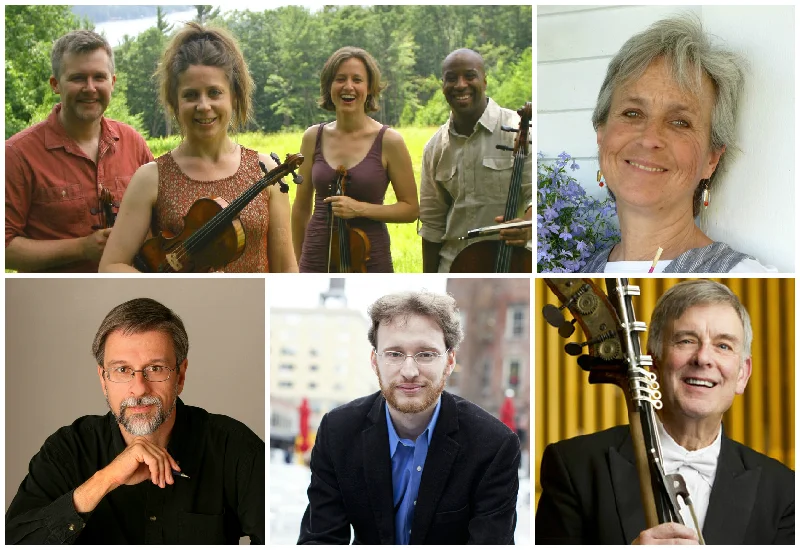
Announcing our final concert of 2014-15: The Apple Hill Quartet and Friends
We're delighted to introduce you to the musicians and composers featured on our final concert of the 2014-15 season: The Apple Hill String Quartet, Peggy Pearson, oboe, Lawrence Wolfe, bass, and James Primosch and Eric Nathan, composers of a new oboe quartet and a new Song for the Spirit, respectively. Stay tuned for their interviews as we approach the concert!
The internationally beloved Apple Hill String Quartet joins oboist Peggy Pearson for Winsor Music’s final concert of the 2014-15 season at St. Paul’s Church in Brookline on Sunday, April 26th at 7pm. Celebrated composer James Primosch presents the Boston premiere of his new quartet for oboe and strings, and Winsor Music concludes a season-long exploration of Haydn's chamber works with the Symphony Quintetto, an exquisite chamber arrangement of his Symphony No. 97. The Apple Hill String Quartet performs Brahms’ lyrical and turbulent String Quartet in A minor, Op. 51, No. 2. Composer Eric Nathan adds to Winsor Music's collection of Songs for the Spirit with a hymn setting of Emily Dickinson's “Hope” is the thing with feathers.

Since its founding in 2007, the Apple Hill String Quartet has earned praise around the world for its concerts presenting interpretive mastery of traditional repertoire – including Haydn, Mozart, Schubert, Schumann, Beethoven, and Ravel – as well as for world premieres and commissioned pieces. As resident musicians at the Apple Hill Center for Chamber Music, the Quartet is featured in the summer concert series held every Tuesday night at the Center in Nelson, N.H. These concerts attract hundreds of visitors and have become a mainstay of the Monadnock area summer music offerings.

When honoring him with its Goddard Lieberson Fellowship, the American Academy of Arts and Letters noted that “A rare economy of means and a strain of religious mysticism distinguish the music of James Primosch… Through articulate, transparent textures, he creates a wide range of musical emotion.” Among the honors he has received are a grant from the National Endowment for the Arts, a Guggenheim Fellowship, three prizes from the American Academy-Institute of Arts and Letters, a Regional Artists Fellowship to the American Academy in Rome, a Pew Fellowship in the Arts, the Stoeger Prize of the Chamber Music Society of Lincoln Center, and a fellowship to the Tanglewood Music Center where he studied with John Harbison.

Peggy Pearson is a winner of the Pope Foundation Award for Outstanding Accomplishment in Music. Lloyd Schwartz, who received the 1994 Pulitzer Prize for Criticism, called her “my favorite living oboist.” Ms. Pearson is Artistic Director of, and oboist with Winsor Music, a founding member of the chamber group, La Fenice, with performances at Winsor Music, the Skaneateles Festival in New York, Maryland’s Eastern Shore Chamber Music Festival, and the Union College Series in Schenectady, New York. Ms. Pearson has toured internationally and recorded extensively with the Orpheus Chamber Orchestra, and has appeared with the Boston Symphony Orchestra, St. Paul Chamber Orchestra, and Emmanuel Music Chamber Orchestra as principal oboist, the Chamber Music Society of Lincoln Center, and Music from Marlboro. She has been on the faculties at Songfest, The Tanglewood Music Center (Bach Institute), the Conservatory of Music (University of Cincinnati), Wellesley College, the Composers Conference at Wellesley College and the Longy School of Music. She is currently on the faculties at Boston Conservatory and MIT (Emerson Scholars Program).

Lawrence Wolfe joined the Boston Symphony Orchestra bass section in 1970, becoming the orchestra's youngest member at that time; he was named assistant principal bass of the Boston Symphony Orchestra and principal bass of the Boston Pops Orchestra during the 1981‑82 season. A graduate of New England Conservatory, Mr. Wolfe studied double bass with William Curtis, Leslie Martin, and Gary Karr. As a fellow at the Tanglewood Music Center, he was awarded the Albert Spaulding Prize for the most promising and outstanding instrumentalist. He is now a faculty member at Boston University, New England Conservatory, and the Boston Conservatory. Represented on Titanic Records by his album, Lawrence Wolfe, Double Bass, Mr. Wolfe has appeared as soloist at Carnegie Recital Hall, NEC's Jordan Hall, Kilbourne Hall in Rochester, and Symphony Hall, where he has been a soloist with the Boston Symphony Orchestra and the Boston Pops Orchestra.
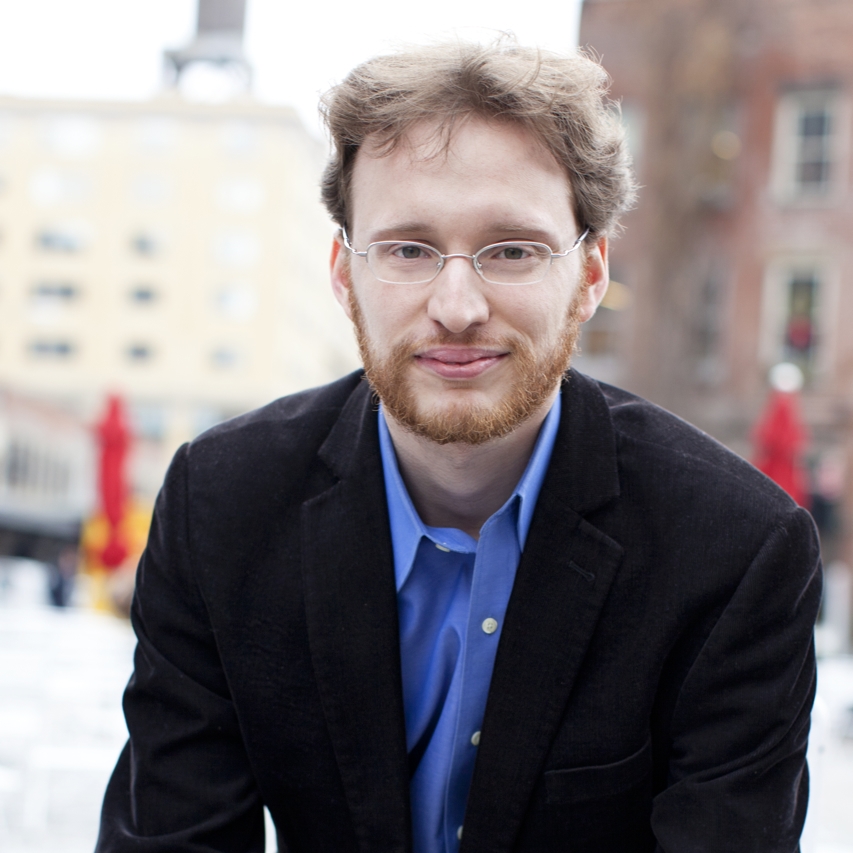
Eric Nathan, a 2013 Rome Prize Fellow and 2014 Guggenheim Fellow, has garnered acclaim internationally through performances at the New York Philharmonic’s 2014 Biennial, Carnegie Hall, Aldeburgh Music Festival, Tanglewood Festival of Contemporary Music, Aspen Music Festival, Cabrillo Festival of Contemporary Music, Ravinia Festival Steans Institute, Yellow Barn, 2012 and 2013 World Music Days, and Louvre Museum. His music has additionally been featured by the Berlin Philharmonic’s Scharoun Ensemble, Boston Symphony Chamber Players, Nouvel Ensemble Moderne, American Composers Orchestra, Omaha Symphony Chamber Orchestra, A Far Cry and the JACK Quartet.
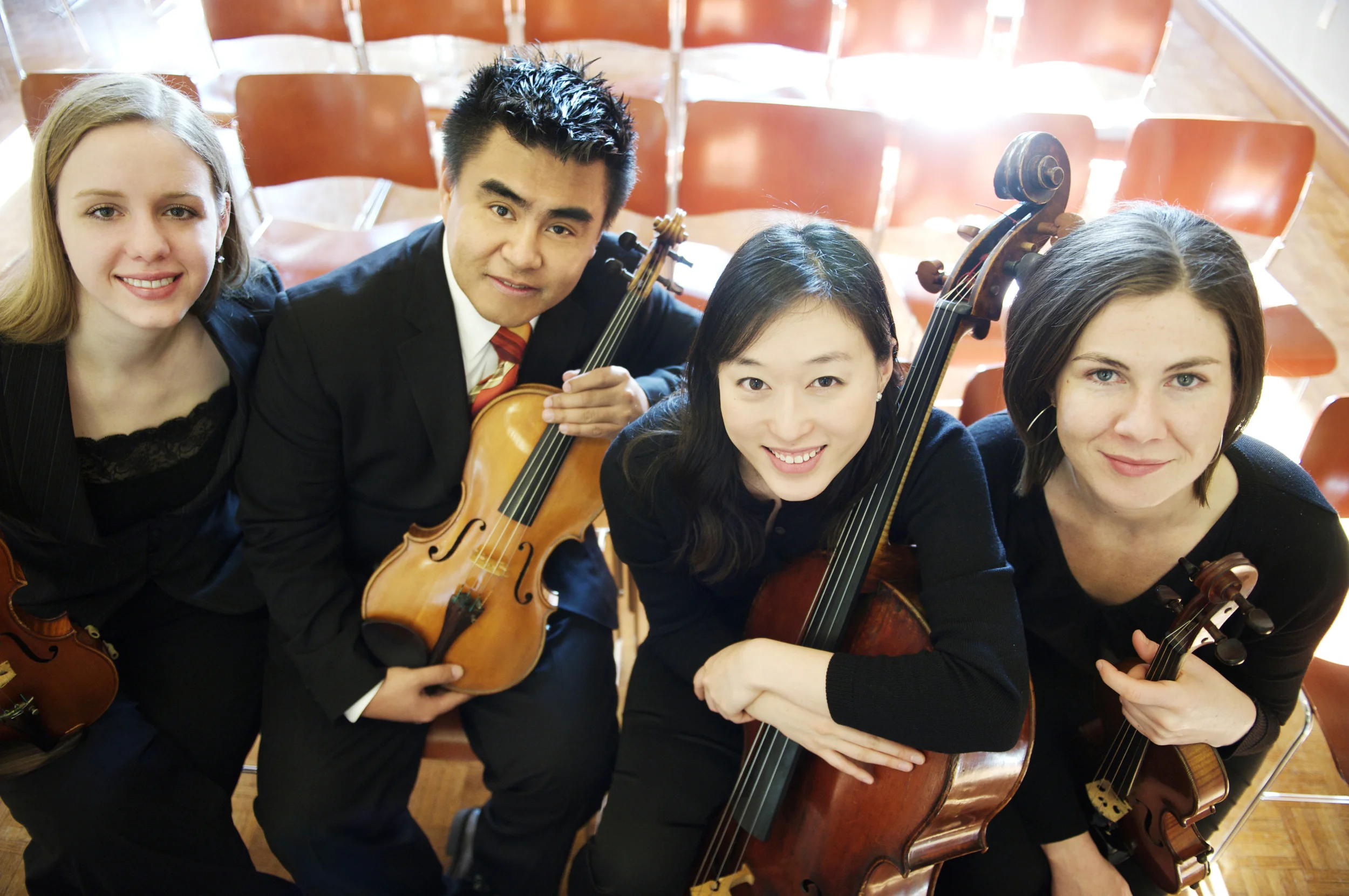
Meet the Arneis Quartet!
The Arneis Quartet celebrates their fifth anniversary this season with appearances on the Alcyon, Emmanuel Music, and Winsor Music Chamber Series, where they will perform on the March 23 concert. Heather, Rose, Daniel, and Agnes very generously gave some rehearsal time to speak with us about the origins of the quartet, their favorite moments in the music for the March 23 concert, and why they love performing on outreach concerts.
The Arneis Quartet celebrates their fifth anniversary this season with appearances on the Alcyon, Emmanuel Music, and Winsor Music Chamber Series, where they will perform on the March 23 concert at the Visiting Nurse Assisted Living Community, one of the first concerts to combine a traditional concert series with a musical outreach program. Widely regarded as one of the finest emerging quartets of their generation, the Arneis was hand-picked by the St. Lawrence String Quartet for its inaugural John Lad Prize, received a fellowship at the Aspen Center for Advanced String Quartet Studies for the summer of 2012, and acted as the 2011 Young Artist Fellows for the Apple Hill Center for Chamber Music. The musicians of the Arneis Quartet — named after the Arneis grape, a varietal that is difficult to grow, but which yields an exquisite white wine — are on the faculties of Boston University, Brookline Public Schools, the Chestnut Hill School, and act as coaches for the Boston Youth Symphony Orchestras.

Photo by Liz Linder
Heather Braun, violin (HB); Rose Drucker, violin (RD); Daniel Doña, viola (DD); Agnes Kim, cello (AK); very generously gave some rehearsal time to speak with us about the origins of the quartet, their favorite moments in the music for the March 23 concert, and why they love performing on outreach concerts.
What brought you guys together?
DD: The idea of the quartet started as my doctoral chamber recital. I had always loved playing quartets and I wanted to put a serious quartet program together so I asked Rose — we’d been playing together since grad school in 2003, so more than 10 years — and we got a quartet together, which was originally Rose, me and two others. That was the first iteration of the Arneis Quartet. We did well, we went to festivals, and then the other two moved or didn’t want to continue, so we found Heather and Agnes, and we’ve been together ever since!
HB: Something that’s really nice is that we’re all BU [Boston University] alumni; Rose and I both studied with Peter Zazofsky, and we all studied chamber music with the Muir Quartet, who are in residence at BU, and we all went to graduate school here as well. We’re all coming from the same ideas and influences, using our graduate studies, so it seemed like a really good fit.
I saw on your website that you got your name from the Arneis grape, and I’m wondering if there was a story behind that selection.
RD: It’s a wine grape, and we like all things that have parallels between wine-growing and music-making, and this grape particularly was almost extinct, not being cultivated very much. It was saved and became a specialty kind of wine. It’s a white wine, from the Piedmont area of Italy. It’s a kind of funky, interesting wine, and you don’t see it around very often, but it’s delicious! We liked the idea of cultivating something — we feel like chamber music is something you cultivate — and the growing of the grapes is a good metaphor, too… and also we just like to drink wine! Finding a name for a group is one of the harder things [about having a chamber group]… rehearsing is easy compared to coming up with a name! It resonated with us: the background of growing, cultivating, and enjoying special and unique, like with music!
DD: The name also translates as “little rascal,” so sort of mischievous...
RD: Right, it’s a difficult grape to grow, so the name is a slang word that sort of means rascally, or something difficult, and cheeky. We liked that playfulness.
DD: The four of us have our cheeky moments in rehearsal, which is after the fact, but it’s still a perfect fit.
RD: It worked out!
How did you get connected to Peggy and Winsor Music?
RD: Heather and I have been playing at Emmanuel Music for a long time, so we know Peggy from there, and also from freelancing in Boston, she’s wonderful, an oboist extraordinaire. So we’ve played with her in lots of different orchestras, and Heather and I have both played as individuals on Winsor Music chamber concerts.
HB: Last summer, she needed somebody to play at the VNA for the June outreach concert. It was a very last-minute thing, and she said “Can you guys come and do this?” and I said, “Yeah, actually, we can!” So we just made it work, and it seemed to go really well. We really loved doing it, and we really like being there. We do a lot of outreach; we play at Newbridge on the Charles, and we do string quartet presentations for the Community Connections program at Emmanuel Music, playing at Boston Arts Academy and other schools. It just seemed like a good fit, and the first time was a success, and we have returned a few times. Peggy eventually asked us if we wanted to play this upcoming concert, which was really exciting! It’s the first concert of the series at the VNA, which is so great!
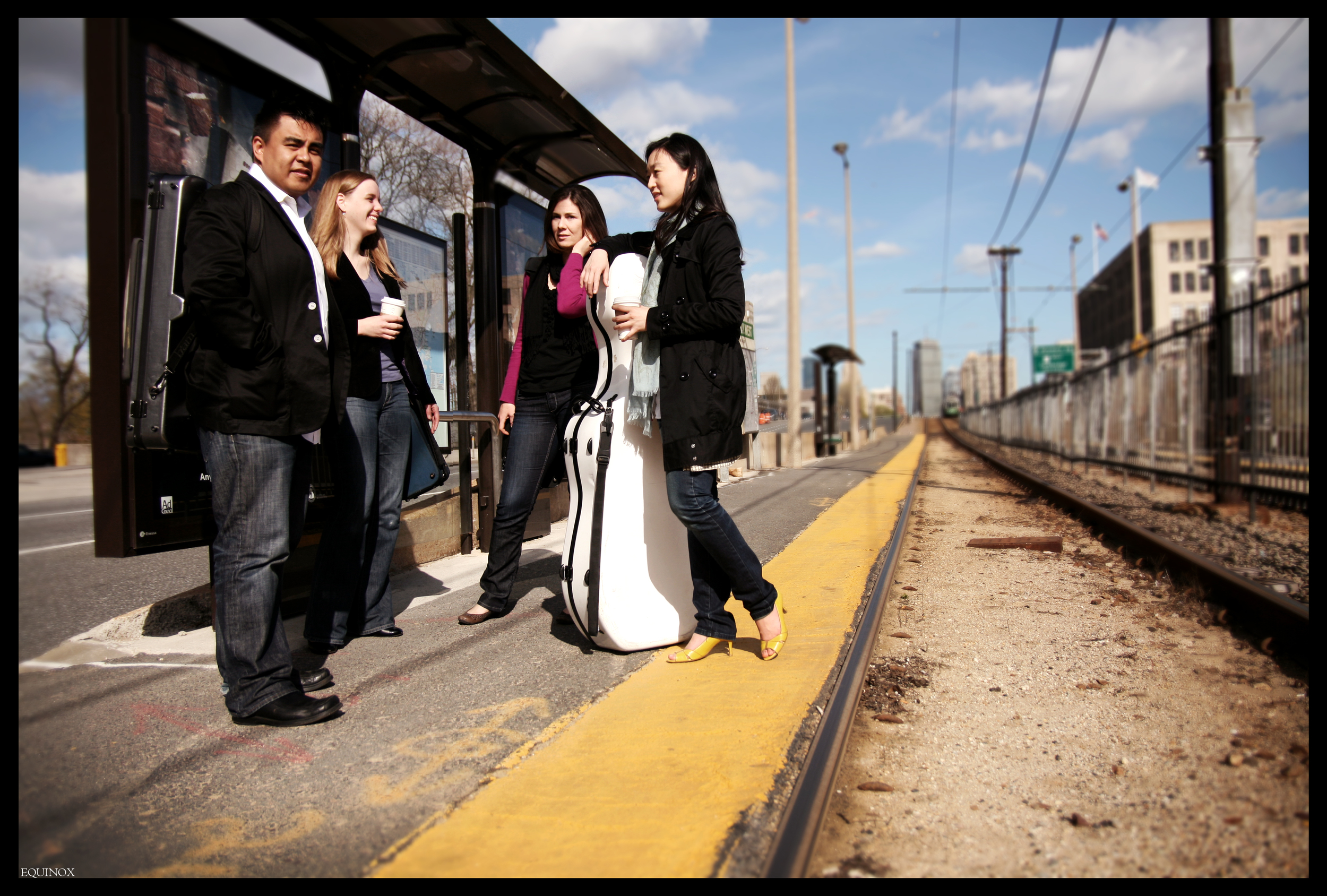
Photo by Eugenia Chung
Have you done anything like this before as a quartet, where you’ve combined an outreach event with a concert series, or a more widely advertised concert?
HB: When we play at Newbridge on the Charles, it’s not advertised the same way as Winsor is advertising this one, but it is the same idea. Families of the residents who live there come to the concerts. The last concert we had there in January was maybe the most well-attended concert we’ve done at that venue, there were a lot of people there. I feel like the more we play there, the more people hear about us and then come to the next concert. It’s a full concert program but we also talk a little about the music and then we play. It’s the same kind of idea as Winsor. Last year we did a lot of concerts at Windham Terrace, which is in Windham, New Hampshire, which is also an assisted living community. It’s something we’re really comfortable doing — we’ve done it in four different places at this point, including an assisted living home in Italy! — and we really enjoy it!
DD: A few years ago, we played on the Stanford University Concert Series, and they set up a bunch of outreach programs at schools and assisted living facilities as well. We’ve been doing this for quite a few years, and we love it. Sometimes we find that our greatest musical moments happen at this kind of concert, because the audience is sometimes a lot more receptive, and we can take risks; it’s a pretty awesome experience.
HB: They’re there just to listen, there’s no judgement happening, and we’re easier on ourselves, which makes it easier to play.
RD: A lot of times we’ll find things in those performances — especially if we’re doing an educational kids concert, when we’re trying to find out what’s going on in the music and we talk about a lot of the concepts, and we bring things together for the kids — then the next time we play that piece, we find we have a whole new fresh set of ideas and things can really come out in our concerts that we’ve discovered during these outreach concerts. We’ve done a lot of different events. We pretty much say yes to everything and then do it, so it’s given us a lot of great opportunities for different venues and different audiences.
You’ve played several times at the VNA, and I’m wondering if there’s anything you in particular that you enjoy about it as a venue. I know from my personal experience that it’s a great room to perform in, and the audience is so responsive.
RD: All of those things! We like the sound of the room and the audience is great. We’ve had repeat audience members who remember us, and we like to talk to them afterwards. Everyone seems to enjoy it. It’s a fun thing to do, for sure.
HB I like the atmosphere that Peggy creates for the concerts, too. She’s always there, and she will sometimes have a back and forth with us. We’ll talk about the piece, and then she’ll ask us a question, or ask us to explain more clearly.
RD: There’s a personal touch.
HB: Right, which is nice, because since she knows us, she feels able to do that. I wish that would happen more often, that people would ask us questions in an open forum. We’re already breaking down the barrier of the audience and performers by having people talk so much more in concerts now than they used to, but I like that back and forth, question and answer stuff. That doesn’t really happen at our other concerts, if we talk to people it’s much more one-on-one. The nice thing about having Peggy there at the VNA with us is there’s this nice dialogue. It’s fun for us and I think the people who are there enjoy it too. The space there is also really nice, and I really like the cookies...
You’re playing Beethoven’s Op. 132 on March 23. It’s said to be reflective of his experiences as a convalescent, and I’m wondering if you find that narrative captures the quartet for you, or if you feel that there are other influences or stories happening throughout the piece.
RD: That’s definitely going on specifically in the third movement. It’s a prayerful song of thanksgiving interrupted by these bursts of feeling better. That storyline is definitely present in the third movement. The outer movements of the piece show where the late Beethoven quartets were going. You can see counterpoint getting really complicated but also really simple and these motives that play together; it’s very much the late Beethoven style all in one piece. The story of the convalescence… I don’t know how much that has to do with how much we like the piece… I think we just resonate with the piece because it’s amazing. It’s this picture into Beethoven’s mind as he was dealing with the end of his life. With the late quartets you can’t help but think that these were the last pieces he was writing after all of the other amazing work that he had done. He came back to some simpler forms but also got really out there, really creative. We think of Beethoven as being a firmly classical composer, but he did some wild things, especially in this piece.
DD: This is the first quartet he wrote that broke the mold of four movements. He was starting to say, “Ok, it’s been like this, Haydn set it this way, I’ve done it this way all my career,” and then here he decides to write something that’s in five movements, even though we debate that it’s actually four movements with a little intro, but… he labeled it as five. It’s a lot of really exciting work. For me, thinking that he had this illness and he was healed gives the third movement a special weight. He’s definitely being very spiritual in that movement, it’s hard not to be affected by that.
HB: I think all of the late Beethoven quartets have this sort of spiritual undertone. To me, every one of the late quartets has a movement where he is talking to God and taking stock of his life. This was his way of talking through things at the end of his life. The third movement in 132 is actually kind of random in terms of the piece as a whole: the first movement is so stormy, and the last movement is so stormy, and the second movement is very pastoral, it’s almost like something Mozart would have written if he had lived another thirty years.
DD: In a lot of ways, he’s looking backwards. In that movement, he’s looking back to Mozart’s simplicity. In the third movement, he writes it in the Lydian mode, which is looking back even further. He’s looking forward and back.
RD: There’s a tension there, looking at the history that has brought us to this point, and then launching us forward, too.
HB: Every one of the late Beethoven quartets has a slow movement that sets the pace for the whole piece. They’re the centerpiece for everything.
In answering my last question, you gave us a lot to listen for, but I’m also wondering if each of you could pick out a particular moment in the piece that you want the audience to listen for and experience with you.
RD: The whole third movement, it’s definitely the centerpiece of the quartet, you can’t miss it. The whole tone shifts, and time stops. It’s my favorite part. It has this timeless quality. I do like the storminess and turbulence of the first and last movements — HB: It’s very Beethoven. — RD: Yes, the stormy seas feeling, I definitely like that, too. And there is a surprise opera moment where the first violin delivers an accompanied recitative before we go into the last movement.
AK: Also, as a cellist, I want to point out that usually in a string quartet, the cello plays the bass line, but in this piece, he breaks that rule and I get to play a high melody with the violin while Dan plays the bass line. — DD: Yay! — AK: Throughout this piece, you can find that it’s not just one person playing the whole phrase, it’s combined, so we switch off. We try to rehearse and make that sound like one instrument, not four different instruments in the phrase.
HB: I would definitely say that people should listen for the end of the last movement, where the first violin and the cello are playing the melody together. For me, it’s high but it’s not that crazy, but for the cello, it’s really crazy high for her. It’s really unique, it’s unusual for that time. When the cello is up that high, it’s a very unsteady feeling… — RD: Almost desperation. — HB: A little bit! It’s definitely something to listen for.
RD: I liked Agnes’ point about the fragmented melody lines, where one instrument might play a few notes, it gets passed around the whole quartet. That kind of fragmentation is fun for us to work on and I think interesting to listen to.
DD: In general, especially with this quartet, and in a lot of Beethoven, being aware of what he’s setting you up for and what you expect to hear, then hearing the curveballs. Getting that can really add to your listening experience. You don’t have to know anything about theory, you just listen with open ears and think, “Ok, I expect this to happen,” and then Beethoven throws you these curveballs all over the place. Be open to being surprised.

Photo by Eugenia Chung
How did you choose the Wallace quartet pale reflections...? Have you played much of his music before? Do you have a relationship with him as a quartet?
RD: Yes to all of those.
HB: John Wallace is a composer here at Boston University, and about this time last year he approached us and said “I’d like to produce and release a CD of some of my chamber music, would you guys be interested?” He wanted to do this quartet, his piano quintet, and a piece for string trio, bassoon and flute. We started working on his music over the summer, and the recording project was scheduled for the end of September. As we started working on this quartet, we realized that this fits a great need in our repertoire: something contemporary and American by somebody we know, and we like it, and it’s about six minutes long. So often when we’re programming for library concerts or outreach concerts, we need something contrasting and short to go with the long and expansive pieces. We’ve been playing it a lot this season and we’ll continue to play it because we really like the piece, we find it very interesting. It’s really different, it’s maybe not the easiest thing for some audiences to hear for the first time; if they heard it a lot, they would be really into it. It’s going to be shocking for some people, but it’s great, because it’s shocking, and then it’s over. It’s so short! It’s a really great introduction to contemporary music for people who haven’t heard it before. It fits that niche perfectly. We know John Wallace, and we’ve been working with him for about a year on this music. The CD will come out soon.
DD: It’s in the final editing process.
HB: Peggy said, “Can you play something short, American, and contemporary?” and we said — everyone chimes in unanimously — All: YES! — HB: If people want to know what it’s like, it’s a lot like the quartet music of Berg, or Webern, where there are a lot of really short compact ideas that are kind of interspersed throughout every part randomly and unexpectedly.
RD: We like to talk a lot about gestures, instead of a melody or a tune, there’s a gesture, an idea that’s expressed through a shape or a kind of sound. There’s a lot of passing around of the gestures in smallish fragments. I think it’s pretty interesting to listen to, all knit together. And as Heather said, if you don’t like it, it’s over quickly!
HB: It’s a really good introduction for people who haven’t heard this music before. If you’ve been going to Winsor concerts for a while, it’s going to sound fresh and original, but it won’t be shocking.
AK: This piece doesn’t contain a nice conventional melody, but it’s very emotional, which is what I like about it. With a lot of contemporary music, it’s interesting and new, but it’s lacking emotionally. This is a very emotional piece, so I think people will like it.
RD: I think that’s a big part of why we like it, too. We don’t have a big affinity for purely intellectual music. I think all of us like to be expressive.
DD: Yes. And when we were working with him on the piece, we were learning the nuts and bolts of it, and trying to get it all together, but he was always stressing that it needed to be expressive. Having the freedom from the composer to do that really helped the piece to resonate with our aesthetic.
Do you have any idea where the title of the piece came from?
RD: It’s nighttime music. There are moon shadows, and it all has to do with night. It goes from dusk until dawn. The first movement is night falling, the next one is the moon, and then sunrise, and dawn. It’s darkness and night music and scurrying. There are some scary things and nice things, in a dream sense.
As with the Beethoven, if you could each pick out a thread that you would really want people to latch on to, what would you choose for this piece?
HB: There are a lot of extended techniques, by which we mean that we use our bow or our left hands in ways that are not normal or traditional. So instead of a regular pizzicato, where we pluck the string, he’ll use something called a Bartók pizz, which is where the string is rebounding off of the fingerboard, so we’re lifting the string instead of plucking the string, so it has a snap sound. It’s technically called a snap pizzicato, but it’s something that Bartók uses a lot, so that’s the common name for it.
RD: Yes, listen for the sound effects, different things we do with our bows: tremolos, slides, colors and effects that create an atmosphere, as opposed to just drawing our bows across the strings like we do in the Beethoven. There are lots of other ways that we can create sounds. It’s very organic, the way that he uses those effects to weave a texture. Definitely listen for those sound effects and special colors.
DD: Performing those sounds can be really tricky!
HB: And the silences, listen for the silences. Especially at the end of the last music, where it’s very suspended. Silence is a part of the piece as a whole.
AK: Listen for the emotional moments. The emotional changes happen so quickly. There will be this blast of emotion and then silence. Also, listen for the quartet’s sound as a whole, on the score itself, it looks like the individual line does not have to do with the other parts, but all together, it creates such a great block of sounds and tones.
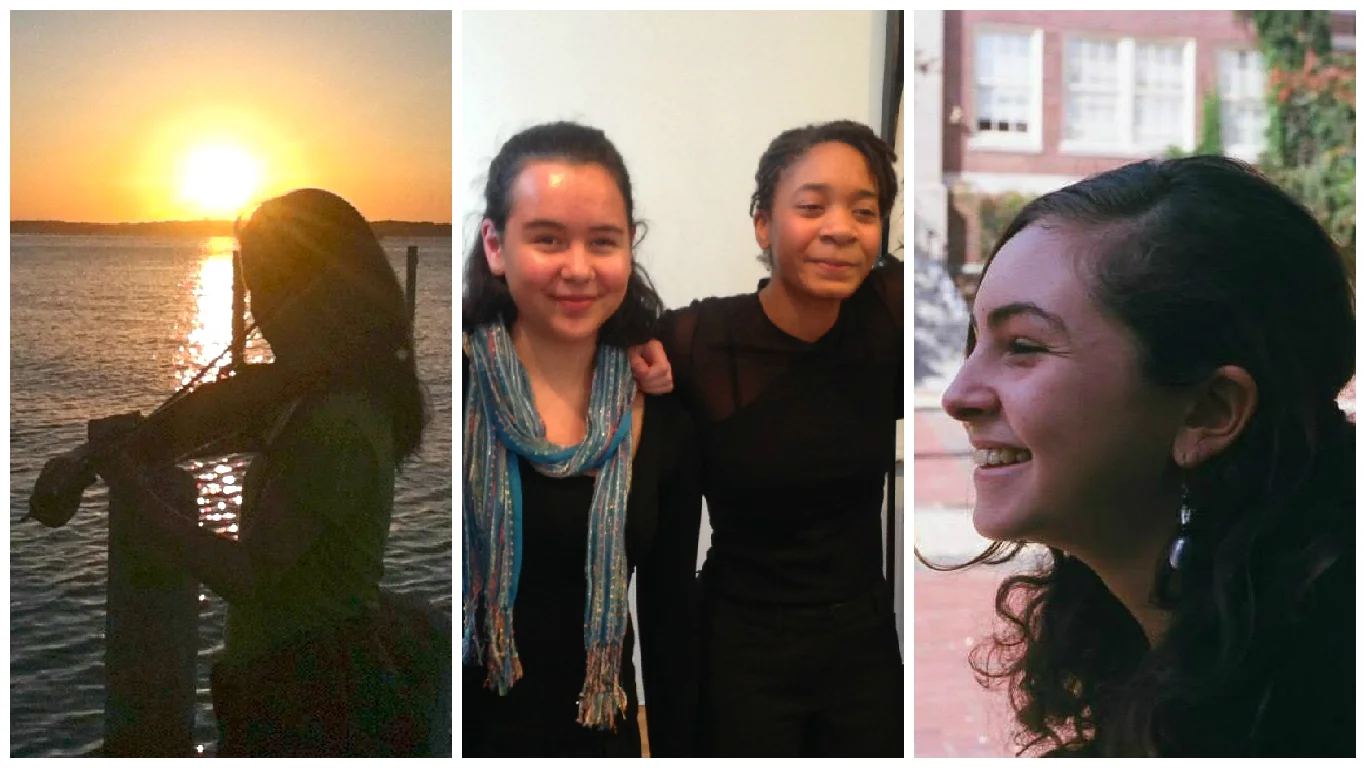
Violobos: Did you know...?
Which Violobos member wants to play the bagpipe? Who performed in a bathroom once? Which composer would two out of three members go back in time to visit, and maybe even marry? Learn more about these fantastic and funny students if you missed our post on Facebook!
For any of our blog readers who aren't on Facebook!
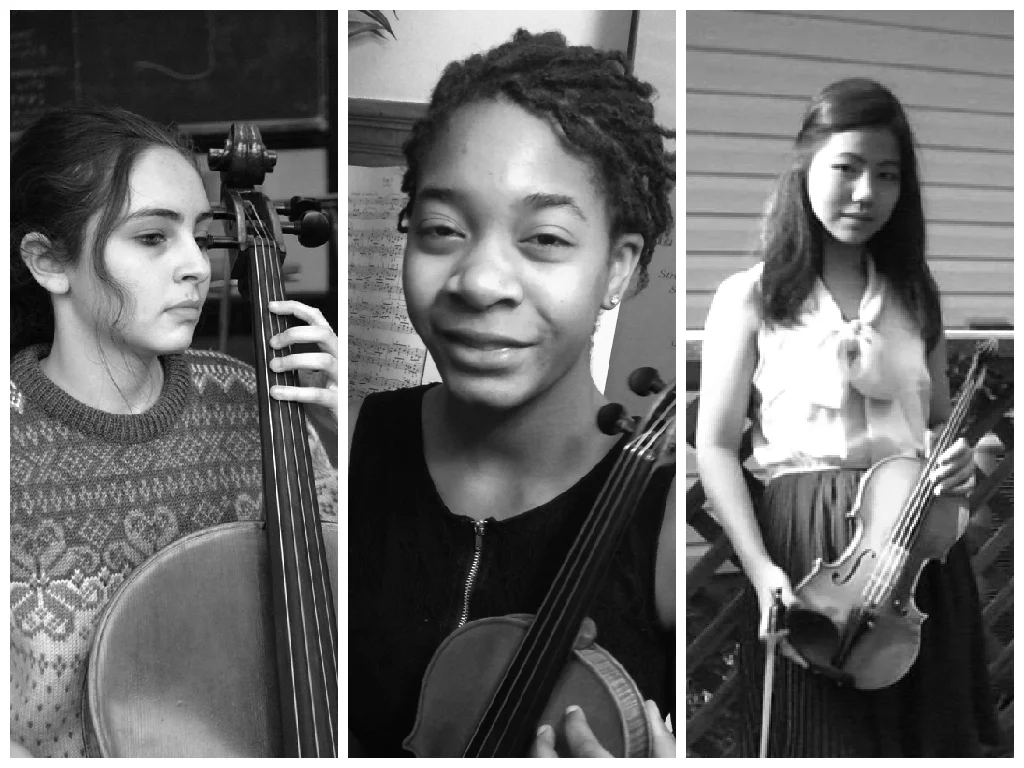
Introducing VIOLOBOS
We are pleased to introduce you to the members of Winsor Music's newest quartet: Violobos! Mitsuru Yonezaki, violin, Njioma Grevious, viola, and Alma Bitran, cello, are outstanding high school students who were personally selected by Peggy Pearson, oboe, to participate in a long-term mentoring and performance program in the form of a regular oboe quartet. At a recent rehearsal, Mitsuru, Njioma, and Alma took fifteen minutes to give a group interview.
We are pleased to introduce you to the members of Winsor Music's new quartet: Violobos!

From left to right: Mitsuru Yonezaki, violin; Njioma Grevious, viola; Peggy Pearson, oboe; Alma Bitran, cello.
Artistic Director Peggy Pearson formed Violobos after our most recent benefit concert, on which all three of these outstanding students performed; they demonstrated an admirable work ethic, a high degree of musicianship, and an easy, natural chemistry when performing together. Violobos will provide them with multiple opportunities for different kinds of performances (outreach, house concert, concert series) through and with the invaluable experience of an ongoing mentoring relationship with a working professional musician.
At a recent rehearsal, Mitsuru, Njioma, and Alma took a fifteen-minute break to discuss their new group, their musical wish-lists, and their upcoming debut on March 23.
Winsor Music: Please tell us your name, class year, how long you’ve played, and who you study with.
Alma Bitran, I play the cello, I’ve been studying for 9.5 years, and my teacher is Ron Lowry.
Mitsuru Yonezaki, I am a sophomore, and I’ve played the violin for about 12 years, and I study with Joanna Kurkowicz.
Njioma Grevious, I’m a sophomore, I’ve been studying violin for 10 years, viola for 2 years, and my current teacher is Irina Muresanu.

Mitsuru Yonezaki, violin
All three of you are in the Boston Philharmonic Youth Orchestra and now Violobos. How do you balance these prestigious musical groups with being full-time students and teenagers?
AB: I just try to do the best I can with everything. I try to not have too much on my plate at once. I have enough time to balance school and music. It can get tricky sometimes, but it’s manageable, usually.
MY: For me, being a teenager isn’t really like going out with school friends, it’s more like being in the music world, so that kind of makes it easier. — WM: Your social life is your musical life? — MY: Yes.
NG: I’d have to agree with Mitsuru. My musical life is my social life. It can sometimes be difficult to manage my time. More times than not, I have to figure out whether an English assignment due tomorrow should be completed before I practice or visa versa, but I work it out.
Do you think learning to do that balancing act has been good for you in the long run?
NG: Yes, definitely.
Have any of you played in chamber groups before, and if so, have you done anything like Violobos, where you play with a professional on a long-term basis?
AB: I’ve played in lots of chamber groups before, but never like Violobos. I’ve never done anything [long-term] with a professional.
MY: Same. Well, for me, I do [chamber music] in the summer. We do three in the summer and one in the winter, so that’s my experience. And we do get to sightread chamber music with some professionals, but never anything year-round.
NG: At the moment, I have three running chamber music groups, but Peggy has really been the long-term professional with whom I have been working. Working with her has been an adventurous learning experience.
What experiences so far would you say are unique to this group?
AB: Playing quartets with an oboe! I’ve never heard of that being done.
NG: I feel a warmth and comfort playing with Violobos. I’d say it’s a combination of our deep love for music and the fact that we genuinely enjoy each other.
MY: It’s nice, because we don’t feel too stressed. Peggy’s our coach and also our first violin. It doesn’t feel too stressful. — WM: A good way to learn without the pressure? — MY: Yes.

Njioma Grevious, viola
Does the Haydn quartet tell a particular story to you, or set a particular mood or scene? What would you want people to listen for?
AB: The quartet really tells its own story, and if you’re listening, you’ll hear everything it has to say. The movements contrast, and definitely share their ideas in a very up-front way that any listener can pick up on.
MY: It’s up to the listener because each person wants to listen to different parts. We have a basic idea: this is the way that we want to present it, but it’s really more up to the listener to get what they want out of it.
NG: I agree, although, one thing I think audience members should keep in mind is that Haydn was a court musician for most of his life. I think this theme is particularly evident at the beginning of the 1st movement.
Is there a particular moment or line that you really love and want the audience to hear?
MY: Overall, I love the third movement the most.
AB: I love that violin melody that Mitsuru has in the third movement.
MY: Yes, it’s really different from the rest of that movement.
NG: I love the beginning of the Haydn; I answer to the melody, first played by Peggy.
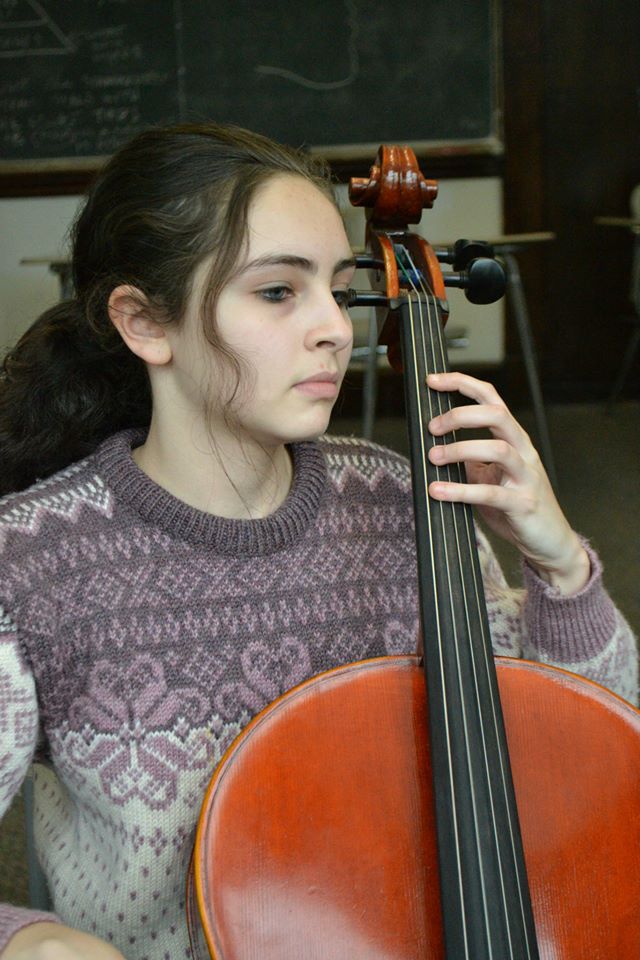
Alma Bitran, cello
Do you have a wish-list of pieces that you’d like the quartet to work on after this piece?
AB: So many… I’ve never played any Beethoven late quartets, I would love to do that.
MY: Peggy said something about trying to play pieces that aren’t too common, so I’m not really sure what to expect! I feel like at this point I only know the well-known repertoire.
NG: I would love to play some Shostakovich ; it would sound so amazing with an oboe.
AB: It might have a really nice quality! I can hear that.
Peggy transcribes a lot of quartets to include the oboe. Are there any particular pieces that your instrument was left out of that you would like to be included in?
AB: I wish I could play all the violin solos in all orchestral music. They’re always the most beautiful parts in every orchestral piece.
MY: I wish I had a concerto like the ones Dvorak or Elgar wrote for the cello.
NG: As a person who plays viola and violin, I think that I have a nice blend of both the melody and the supporting voice — I’m all set.
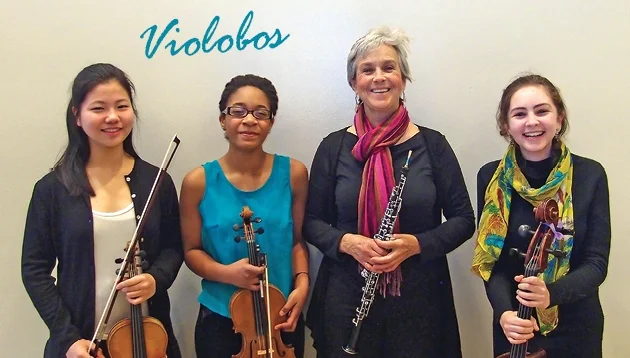
We have a Wait List!
We're excited to say that we've already sold out for our March 23rd concert, but we hope you will make use of the wait list feature built in to our ticketing system. We anticipate that quite a few seats will open up in the weekend before the concert, and we will contact you promptly when these seats become available.

Dear Friends,
We hope that you all made it to the other side of this winter safely! We're looking forward to spring on March 20... and to our next Winsor Music Concert on March 23! This concert will feature Boston's own critically acclaimed Arneis Quartet and the outstanding young musicians of Violobos performing works of Haydn, John Wallace and Beethoven. We hope that you can join us to celebrate high quality performance, community outreach, and mentoring the next generation of musicians as well as the return of spring!
The Visiting Nurse Assisted Living Community is graciously hosting us for this concert in their Community Room, where Winsor Music regularly performs concerts for the residents of the VNA. Given the residential nature of the venue, we are asking that you, our guests, register your free seats in advance at winsormusic.org/tickets. Each guest must have their own ticket, which we will scan at the door. We will have ushers to help direct you to the Community Room when you arrive, and we hope that you will join us in greeting the musicians and residents of the VNA at a reception after the performance.
We're excited to say that we've already sold out, but we hope you will make use of the wait list feature built in to our ticketing system. We anticipate that quite a few seats will open up in the weekend before the concert, and we will contact you promptly when these seats become available. Just register for a ticket as you normally would, and watch your inbox!
If you reserve a seat, but change your plans, please contact us to cancel your order so that we can open that seat up to someone on the waiting list.
We are excited and honored to be hosting the first chamber series concert in collaboration with one of our favorite outreach communities, and look forward to seeing you there!
Thanks,
Peggy Pearson
and the staff of Winsor Music
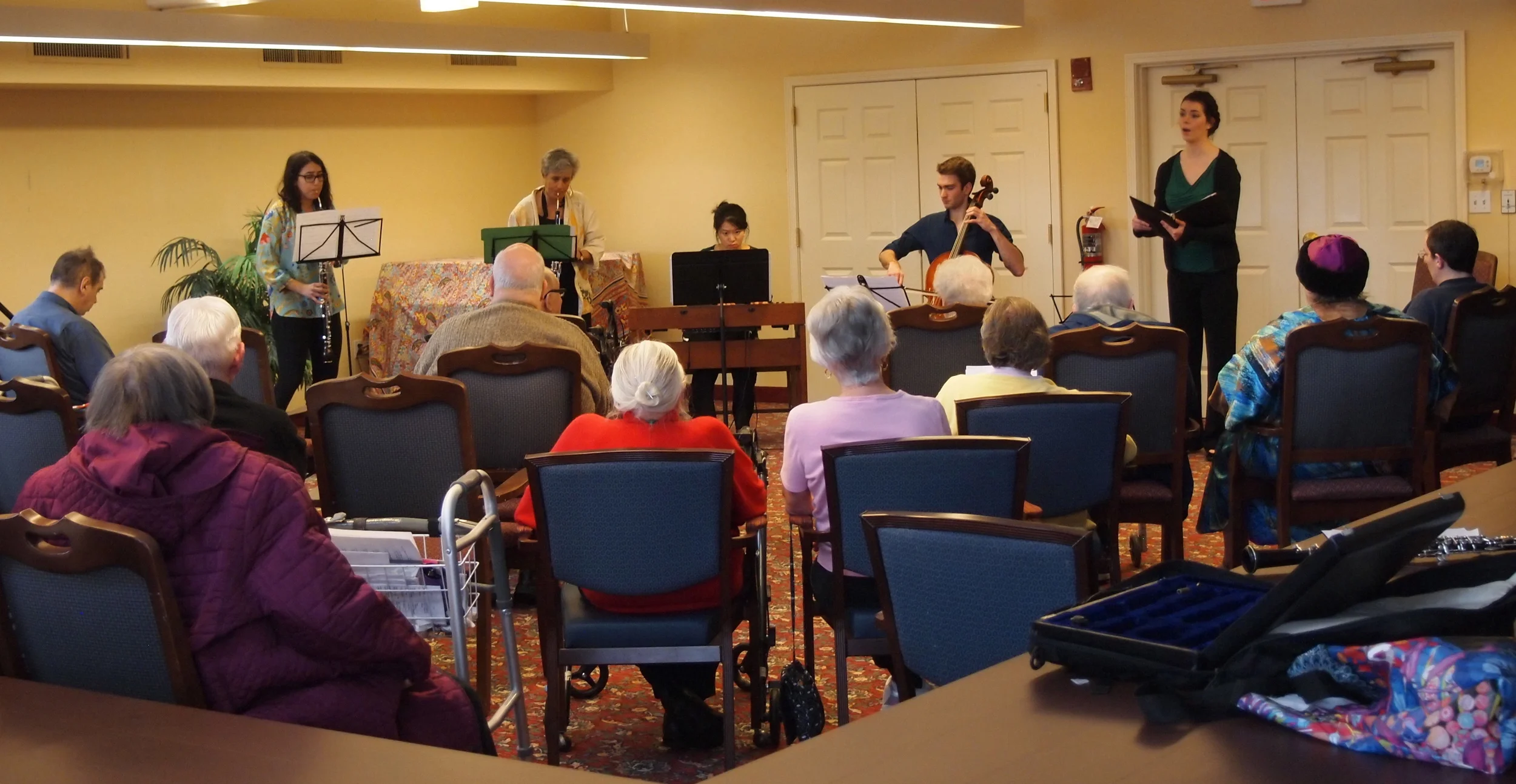
The Bach Institute
As many of you know, this week, our Artistic Director Peggy Pearson is serving as a faculty member and the co-director of the Bach Institute, a collaboration between Emmanuel Music, Winsor Music, and Oberlin College and Conservatory. Currently in their second week, the students are performing their arias in five outreach concerts hosted and facilitated by Winsor Music's outreach and education programs.

As many of you know, this week, our Artistic Director Peggy Pearson is serving as a faculty member and the co-director of the Bach Institute, a collaboration between Emmanuel Music, Winsor Music, and Oberlin College and Conservatory. The Institute is a January-term intensive in which students immerse themselves in the vast repertoire of Bach cantatas that are performed every week by the musicians of Emmanuel Music, many of whom serve on the Institute faculty. Students receive private coachings and lessons on individual arias, perform in the Sunday cantata series at Emmanuel Church, and perform their arias, duets, and a full cantata in the final concert, which will be held on Monday, January 26th, 7:30pm at Emmanuel Church. Tickets are free, but seats are limited, so reserve your spot here.
Currently in their second week, the students are performing their arias in five outreach concerts hosted and facilitated by Winsor Music's outreach and education programs. Peggy spoke to us about why she and co-director Kendra Colton started the institute five years ago, why it matters, and what she loves about it.
What excites you about the Bach Institute?
The Bach Institute is a lifelong dream. The cantata repertoire is not generally studied by instrumentalists or vocalists at the conservatory level, but it's one of the most beautiful and massive repertoires there is.

Why is that?
It's extremely challenging on many levels. For vocalists, this is some of the most difficult music in the repertoire, and for both instrumentalists and vocalists, it's a challenge to create long lines, and to figure out how to phrase such complicated music. Sometimes when we are working out phrasing, we might find that the whole opening ritornello is one big phrase (not twenty!), and part of the struggle is generating the energy to get through such long lines.
Another complication is that, often, the vocal or obbligato line might be doing one thing, and the continuo might be doing another; you have to be open to allowing that to happen, to letting it be complicated and contradictory. That can also be true of the way the music and text fit together; sometimes, it seems as if they are openly contradicting one another, but when you look closely at those contradictions, you might find entirely new layers of meaning to the piece.
How do you address that with the students?
This is difficult! A lot of the time, there is more than one viewpoint expressed by the faculty, and there's a reason for that: there's often more than one viewpoint expressed in the music. You should be able to do it in different ways. The music is so rich and multi-layered, leaving opportunities for many different interpretations. These arias are technically and emotionally complicated and full; it's not easy to figure these pieces out on any level.

What do you think sets the Bach Institute apart from something a conservatory might offer?
The students do benefit from discussion, commentary and conversation with incredible Bach scholars like Robert Levin, John Harbison and Pamela Dellal, but there are a couple of distinguishing factors. One is that they get a great deal of one-on-one time with the amazing teacher Kendra Colton! The other is that they get so much practical performance experience. Whenever possible, the students get to perform in the weekly cantatas at Emmanuel, with our wonderful music director, Ryan Turner, conducting. They see how we put together a cantata in a few hours, and get a feel for what the cantatas are like as a whole, instead of the collection of arias that they work on during the institute.
I also always look forward to the outreach concerts, because it serves so many purposes and people at the same time. It’s a very appreciative and under-served audience, and the students really benefit from performing every aria at least twice before the final concert. We also do a children's concert at the Mather school in Dorchester, and the students write a children's cantata based on an easy, familiar tune that the kindergartners always love. This year it is Twinkle, Twinkle Little Star the Cantata, and the final chorus will be sung by five year-olds!
What are you most looking forward to about the final concert?
It's always astonishing how much progress the students make in two weeks, and of course that is very exciting for us. In addition, it always makes me happy to be in the position to introduce this repertoire to an audience; it’s a Bach Hit Parade, with one gem after another.
Some of us have been playing Bach at Emmanuel for so long that we tend to think of the cantatas by their numbers, and we'll get so excited when people start tossing numbers around, the way Beatles fans do when you start listing hits: "Oh man, I love 159!"... "Oh, that duet in 3 is the best!" This concert is like that, just one great aria after another; it's a Bach lover's heaven.