

Meet Pianist Diane Walsh
La Fenice's pianist Diane Walsh describes her musical background, working with Peggy Pearson, her role in the Broadway play "33 Variations," and the future of chamber music.
La Fenice's pianist Diane Walsh describes her musical background, working with Peggy Pearson, her role in the Broadway play "33 Variations," and the future of chamber music.

How did you first get into chamber music? What was your first chamber music experience?
Well, my first substantial chamber music experience was when I was 16 years old. I went to the Merrywood music camp in Lenox, Massachusetts for two summers. And that’s when I first had the experience of having colleagues and playing duos and trios. It was just fantastic, and, coincidentally, that was the same summer that I met Peggy Pearson! (Although I didn’t play with her, I’ll never forget hearing her play in the Beethoven Eroica Symphony and the Brahms 4th Symphony.)
Pianists in particular tend to be kind of solitary creatures, because the piano is sufficient in itself, and we don’t naturally get thrown together with other pianists. But violinists or singers or oboe players almost always have to play with a pianist, so they’re always interacting. For me, this was a wonderful new thing and I really loved it.
Given the major differences in range and capacity between the piano and string or wind instruments—do you feel that the pianist has a distinct role in chamber music?
Yes. I believe the piano’s role is to support the other players. That’s something that I had to learn, when I was starting out. There’s a different kind of sound that the piano makes when you’re being a soloist. You want to project, and you want to sound brilliant and wonderful; that’s one kind of tone quality. But when you’re trying to blend with other instruments, that’s a different kind of sound. So I learned to make the kind of sound that blends, and also how to be responsive to colleagues. The goal is to blend your sound so that you have a unified tone color, which is hard to do when you’re playing an instrument that sounds so different from the others. So that’s a very rewarding project, that goes over many years and with many colleagues.
So from your experience both as a performer and, I’m sure that you’ve coached chamber music groups…
Yes I have.
And sitting back and listening when your colleagues play something in a quartet, or when you're not participating in a given piece, have you observed that they approach performing with you differently? Because, as you say, even the construction of the instrument is so fundamentally different from those of your colleagues.
Yes. I have occasionally had the experience, when I’m playing with new colleagues, that they’re sort of on edge because the piano can be such a powerful instrument, in terms of volume. It’s so big and you can play ten notes at a time, you know, so it can very easily overpower. So part of my job is to reassure them that I’m not going to drown them out, and I’m going to enhance their sound, rather than compete with it.
You mentioned new colleagues, but I’m going to ask you about some very long-time colleagues in La Fenice. You just told me that you met Peggy so young, and Peggy speaks of your group so fondly as some of her oldest and dearest friends, that the five of you just meshed so well together. You've told us how you met Peggy; how did you meet the other members of the group, how did it come together?
I met Marcy Rosen back in the 1980’s, I think, when we were both playing at the Caramoor Festival— I believe it was St. Luke’s Chamber Ensemble that brought us together. I met Cathy and Maria both through Marcy, because she directs Chesapeake Chamber Music, a festival in Maryland that has been going for thirty years, and I’ve been there almost every summer since the beginning. I’ve been so lucky in meeting and playing with so many wonderful colleagues, but I particularly love playing with the four women in La Fenice.
Did you have a model or a mentor who influenced how you approach chamber music? And not necessarily a pianist, but they certainly can be.
Well, yes that’s a really interesting question actually. I had several mentors when I was still in school. My primary mentor was my piano teacher Irwin Freundlich, with whom I studied from the time I was eleven years old up until I was twenty-one, when I graduated from Juilliard. I didn’t actually study chamber music with him, but tone quality was very important to him, so that helped me when I played with colleagues. I was lucky enough to be coached by Felix Galimir at Juilliard, and also again at Mannes, when I went back to get a belated Masters degree. He was a violinist and played in the Galimir Quartet for over 60 years. He had deep, deep experience, having known Ravel, Schoenberg, Webern and Berg in Vienna, so he was like a conduit to decades of musical history and experience. So I was very fortunate to have been influenced by him. After I graduated from Juilliard, I studied with Artur Balsam for a year, too. He was a renowned chamber music player and accompanist, who played with Rostropovich, Milstein and Oistrakh, and I learned about being a supportive colleague both from his lessons and also from hearing him perform. Both Freundlich and Balsam taught me the importance of being versatile, someone who can be a soloist and also be a considerate chamber music partner.
I see what you mean. So I have to ask, having read your bio, I do have to ask you about "33 Variations."
Oh, sure!
Because it's such a unique point for a musician like you to have in your bio. And I want to know how you got involved in it and that sort of thing, but I also wondered if it was in any way comparable to a chamber music experience, because you were performing live every night with these actors.
Yes, it was actually very comparable. The way I got into it is that a colleague of mine, a pianist named Peter Vinograde, called me back in the mid-2000s, and told me had had gotten a call from a theater company called Tectonic Theater Project. They were creating a theater piece about the Diabelli Variations of Beethoven. Peter didn’t play then, and he knew I did, so he said, “If you’re interested, why don’t you give them a call,” so I did! It led to my auditioning for the playwright, Moises Kaufman, who also directed all four of the productions that I was in. I played for him in this little rehearsal hall near Times Square in New York. It was a bad upright piano, and I played through a bunch of the variations, including the Fugue and the Finale, and then we just chatted about it. At the time, he was obsessed with this piece and the idea of creating a play from it, and I had just performed it a few months before, and was similarly obsessed with it, and something clicked, and that’s how it all began. I took part in a few workshops where he worked out the scenes with actors, and the piece started to take shape into a play, and then we had an out-of-town tryout in Washington, D.C., and two years later we were on Broadway! It was quite a journey! Playing the same music every night was a new experience, too. I was a little worried, but it turned out to be a pleasure, watching the actors perform every night. There were always subtle differences each night, which kept me on my toes. I never got bored, and I never got tired of the piece either, which is a tribute to the greatness of Beethoven’s music. Any other piece might have gotten very old after a while!
I don't know if this is possible, but can you give an example of one way in which you and the actors might have played off of each other in a performance?
Well, there were several monologues where the music had to be exactly times to finish with the end of the speech. A couple of speeches that Jane Fonda had, we rehearsed again and again so that it would time out exactly. The high point for me of the whole play, is towards the end there’s a duet between me and the actor who plays Beethoven. He’s creating the fugue, Variation 32, in his mind, and kind of stomping around the stage in the throes of creation, and he says, “now the theme is in the treble…now it sinks to the bass…pianissimo…forte!” and he describes what should happen in the music a split second before it actually happens in the music. He’s not reacting to what I’m playing, he’s evoking it, for me to illustrate—that’s the theatrical effect, but in fact he has to say it before it happens in the music, which is quite tricky. Plus, once I get going, it’s very hard for me to stop and wait for him—actually, it’s impossible! So we rehearsed that scene for many weeks to get it exactly coordinated. It’s very dramatic, and most nights there was applause which stopped the show. I also had to be loud enough for the music to have full expression, but not too loud so the words couldn’t be heard. That kind of teamwork really is the essence of chamber music!
Did Kaufman have any musical background, did he rely on you, did he use you at all as a resource, as the play was being created?
Yes, he used me as a resource. He does have some musical background, and he plays the piano and reads music, but he is not a musician. He did a tremendous amount of research about this piece, and he became an expert on this one piece by Beethoven, after reading many biographies and analytical works about the piece, but when the play was being workshopped, he did rely on me to answer musical questions. I also suggested some variations which would work with various scenes. When the play ran on Broadway, I was Music Director, and helped rehearse the actors when they sang sections of the Missa Solemnis of Beethoven, as well as teaching them their musical cues for certain monologues. The meshing of music with text was my responsibility too. It was a unique experience for me.
Obviously the last question about that play is, what was it like to work with Jane Fonda?
Well, it was wonderful. She was a great colleague. She’s so famous that the first few seconds meeting her were a little scary, but she was just so natural and welcoming—I mean the first time I met her, she immediately gave me a big hug. So it was very easy to work with her, and she was a really hard worker during the rehearsal process, too. She absolutely was not a diva at all. She hadn’t been on Broadway for over forty years, and preparing something for live theater is really hard work, and she was absolutely a workhorse.
One night when we were both leaving the theater at the same time, she asked me to come have a drink with her at Joe Allen’s. So we got in her limo and rode the four blocks to get to the restaurant, and when we walked in, there, at a round table in the back, was James Gandolfini (who was then starring on Broadway in a different play) waiting for us. So I had a martini with “Tony Soprano,” and he teased me about being a martini-drinking pianist. Actually, I never drink martinis, but it seemed like the right thing that night!
Is the play published in the Samuel French edition now?
Yes, and I helped to edit it before publication. It is a unique document, because it has all of the piano music incorporated into the script, note for note, right where it occurs in the play— about 35 minutes of music.
What an incredible experience. And did you ever think that you would see a play, or let alone be involved in a play, about a musicologist?
*laughter* No, I certainly didn't! And yeah, it really unfolded in a very surprising and wonderful way.
Before we wrap up, I just wanted to know about this upcoming concert. I know that you've rehearsed, and I think performed, most of the pieces from it already down at Chesapeake [Chamber Music], and I'm just wondering, what are some of your "wow" moments for this concert? What are you really looking forward to?
Well, I'm in just one piece, the Brahms G minor quartet, and that is always a sure-fire audience pleaser, because the last movement is a Rondo in Gypsy-style and it is always very, very effective and brilliant, and people always go nuts for it. The last movement of course is very effective and wonderful, and an instant crowd-pleaser, but the other three movements are really subtle and dramatic have a lot of feeling, and I always really enjoy playing Brahms chamber music because it has really special sensibility. And I'm also looking forward to, although I'm not playing in it, Lev Mamuya's pieces: he's a young cellist and composer who Peggy has mentored. You probably know more about it than I do, but I'm really interested in hearing it myself, because I don’t know his music.
Yeah! This is actually going to be Lev's fifth piece for Winsor, which is just amazing. I think he's only 20 or something, so...
There are videos on YouTube of him playing cello when he was eight years old... He's a phenomenon.
Exactly. So, to get the spirit of the season: it is our twentieth anniversary this season, so I wanted to know, what are some of the changes that you've observed in classical music over the last twenty years?
Yikes! I think it just gets harder and harder to... how can I say this? It feels like classical music is losing some of its popularity because it seems harder and harder to get audiences to come. And there's a lot of different reasons for that, but the funny thing is that the people who DO still come to concerts, are just so full of love and enthusiasm for it. So you just get this mixed message from the world, that some people get distracted by popular culture and whatever else is going on in the world that they sometimes forget about these wonderful, timeless masterpieces that are still so full of nourishment for all of us. And yet the people who do still go to live concerts, they're so full of gratitude for the experience. And so, I guess it's kind of a glass half-empty, glass half-full situation: you can look at it as a good thing, you can look at it as a bad thing, depending on your attitude. But just for myself, I'm happy to still be playing music and have people want to come and hear it; I guess that's the bottom line. I enjoy performing, and I'm very glad that performing classical music is still a thing.
What would you like to see happen over the next twenty years? Where would you like to see us twenty years from now?
Well, I think it's up to the next generation. I spent forty years as a teacher, and I've tried to pass along the musical values I learned from my teachers to my students, and and now it's up to them to take that out in the world. And if I look at it that way, I feel very hopeful, because I feel like they're ready to do it, and many of them are already doing it. And, oh gosh, so many issues come up. When I was first becoming a professional musician it was all about, well for a pianist at least, it was all about entering as many competitions as you could, and winning as many prizes as you could, which would supposedly lead to a career. But, I think that chamber music is the opposite of that view: it's more about communication and friendship and emotion and all those wonderful things, and so I think that chamber music may be the saving grace of the whole profession. That's what makes us really feel good as musicians, it's what makes the audience feel good, and so I hope that young people today who are going to be the performers of tomorrow, are aware of how important that is, and how it should be part of their lives. It seems like an increasingly kind of difficult task to take on these days anyway, to hope to be a soloist. And so, chamber music is a built-in, wonderful way to make a difference in the world as a musician. That's kind of a shortened version, but I hope that makes sense.
Well, on that note: this has been brilliant, thank you.
Well sure, my pleasure.

Lev's Interview
Our opening concert this season features the Boston premiere of a work by one of our dear friends, Lev Mamuya. I have known Lev through Project STEP since he was about 3 feet tall and eight years old! He is currently entering his second year of the Harvard/NEC program, and I am honored that he took the time to write a piece for Winsor Music (our 5th from him).
Our opening concert this season features the Boston premiere of a work by one of our dear friends, Lev Mamuya. I have known Lev through Project STEP since he was about 3 feet tall and eight years old! He is currently entering his second year of the Harvard/NEC program, and I am honored that he took the time to write a piece for Winsor Music (our 5th from him).
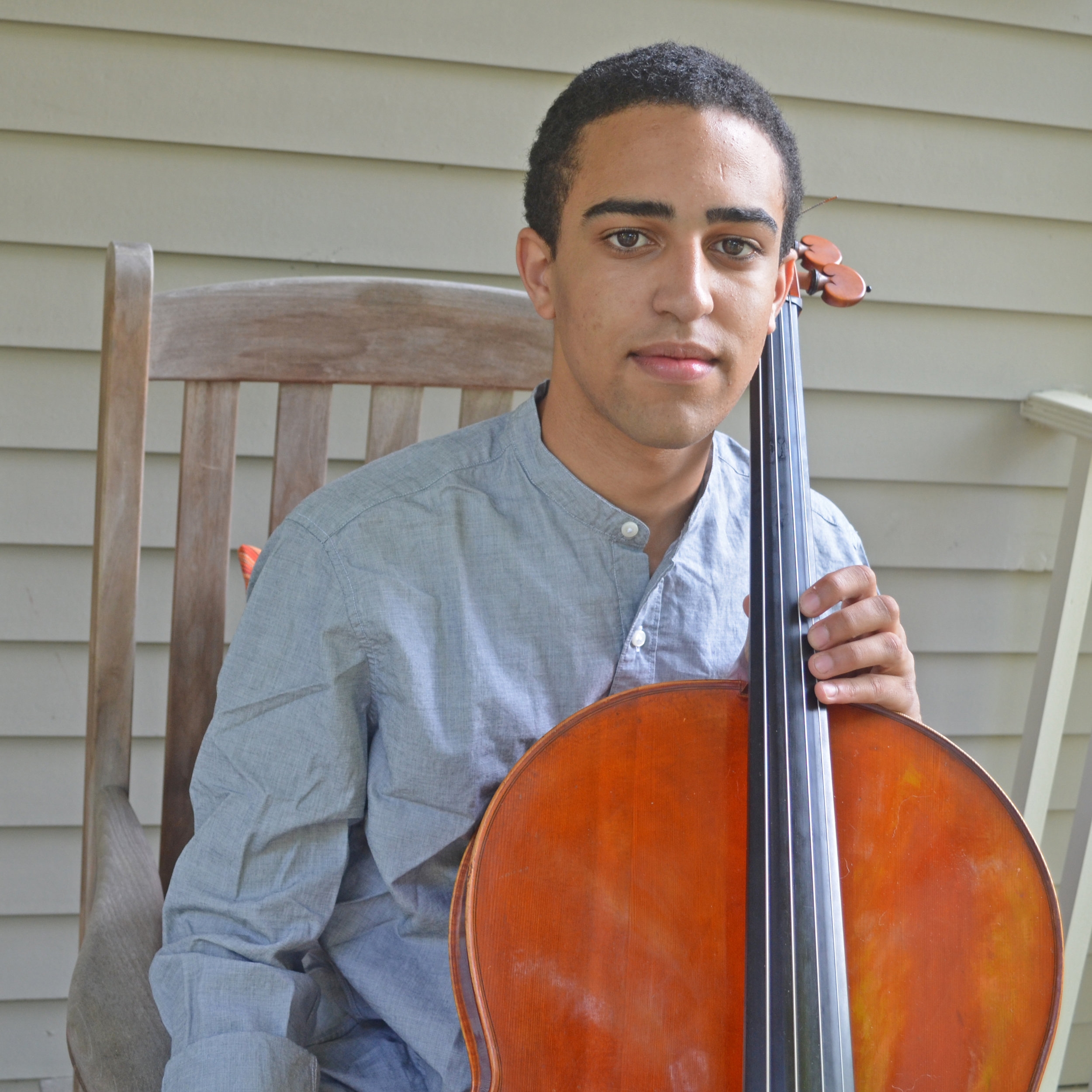
What are your days like in the Harvard/NEC program? What are you currently studying/what are your majors?
Life in the Harvard-NEC program can get busy indeed! Most of my class time for now is spent over at Harvard, working towards my degree in History and Literature, but I make the trip over to the conservatory about twice a week, for lessons and studio class. I'm also a frequent participant in Harvard's Music 189 chamber music course, taught by the fantastic Parker Quartet, and a member of a small, conductor-less chamber ensemble, the Brattle Street Chamber Players. And you can often find me in my upperclassmen dorm's common room late at night, trying to squeeze in just a little more practice time after my homework is done!
How do your liberal arts courses inform your music education/music making and vice versa?
I've always found the dialogue between my academic coursework and musical pursuits as an essential factor in the pursuit of meaningful musicality. "loosely turing," one of the pieces on the program, was inspired by some of the work I did in both a History and Literature class and an installation and video art studio I took during my spring semester this past year. Engagement with historical and literary texts, as well as with various forms and philosophies of performance has been imperative for me in placing different performance practices within a more robust historical context, and deepening my view of the role of the performer in today's society.
Can you tell us about any of your other compositional projects (for school or otherwise)?
Right now, I'm working on a piece to be completed this spring for Brattle. It's the first piece I've written for string orchestra, so it's been an exciting process!
What is your performance life like right now? Do you find yourself gravitating more towards one type: chamber music, solo performance or orchestral, etc? If so, why do you think that is? Is there a type you’d like to be doing more of?
My performance life has been lovely as of late! This summer I did a bit of performing on some of the concerts at the Banff Centre's masterclasses for winds and strings, and during the year, I'm usually active, giving a number of small, mostly chamber performances with friends around campus and the Boston area. I've always enjoyed and gravitated towards chamber performance since I was very young, but I relish the opportunity to really dive into solo repertoire head first as well. This past summer, I studied and performed the Crumb Sonata for Solo Cello, which was an immensely fulfilling experience.
Is there a particularly meaningful performance experience you’ve had during your time in college?
Picking just one performance experience is so hard! This past fall, I performed the Ravel Piano Trio with two wonderful friends and musicians, as the culmination of a semester's work in the Music 189 Chamber Music course. I've also participated for two winters now in an intensive chamber music workshop during the last week of winter break, that's put together chamber music programs for performances at the Harvard Club of New York, and Princeton University. Being able to interact, workshop, and polish pieces alongside a group of dedicated peers has definitely been one of my best musical experiences at school.
Can you tell us about your process for this new Winsor commission? What inspired you? Was there anything about this process or the result that was markedly different from your previous works (either for Winsor or generally speaking)?
This piece, "loosely turing," was, as I mentioned, inspired by a lot of work I did in my History and Literature sophomore tutorial class, which focused on the historical and literary depiction of new media from the advent of the telegraph, up to the modern day. In reading about Turing's work concerning the powers of computation, I marveled at his amazing predictive powers--in many ways, Turing defined bounds of what machines like computers are capable of a considerable time before the invention of such devices, and those bounds remain largely unsurpassed. In my studio art class, I explored many similar themes, especially as the related to the bounds and failings of human perception, and the distinction between humans and machines. Much of that exploration is reflected in the structure of the piece, and the way melodic fragments are stitched together and refracted through different parts of the ensemble. This was really the first composition where I've drawn such direct inspiration from an academic source.
You have performed on all of your compositions for Winsor Music. Do you find that you write differently when you know that you’re writing for yourself as opposed to when you’re writing for someone else/another instrument?
Writing for different instruments and orchestrations is always a unique challenge, and I'm so lucky to have had such support from Peggy when writing pieces for Windsor in understanding how to orchestrate for instruments like oboe, with which I wasn't as compositionally familiar initially. In terms of a distinction between writing for myself and other cellists or string instrumentalists, though, there's no real noticeable difference--it never really enters my mind while I'm writing that I'm writing a part for myself. In fact, a couple of years ago, my teacher asked me to write myself a cadenza for the Haydn D Major cello concerto, and when I had finished, I was astounded at the difficulty of the cadenza, and as a performer was more than a little unhappy with myself as a composer!
A lot of people talk about college as being a time of your life where your mind is constantly being blown wide open. Is there something you’ve learned in the last couple of years that has surprised you or changed your perspective? (The kind of thing that you can’t stop explaining to your family when you’re home on break.)
Just the experience of living by myself in such an exciting community of peers, and engaging with extracurricular, academic, and social obligations is a source of constant amazement for me! I feel as if I've learned a lot about myself and the place I would want to occupy in society as a professional and an adult.

Megan Henderson's Many Songs for the Spirit
Many of you know and love Megan Henderson from her work as a pianist with Winsor Music's concert series and outreach program. We're so pleased to introduce her to you anew as a composer of our newest Song for the Spirit (although anyone involved in the Boston-area Shape Note community has known this side of her work for many years)! We discussed her history of writing music in (and bending the rules of) the Shape Note tradition, how she navigates between many musical traditions and practices, and why, for her, every song looks to the Spirit.
Many of you know and love Megan Henderson from her work as a pianist with Winsor Music's concert series and outreach program. We're so pleased to introduce her to you anew as a composer (although anyone involved in the Boston-area Shape Note community has known this side of her work for many years)! She has composed a new Song for the Spirit, "With Grace We Meet our Trials" or "Jewell Hill" for our concert on October 4, where she will be sharing the program with her former conservatory professor, John Heiss, as well as music of Boccherini and Schumann.
Megan Henderson is a graduate of the New England Conservatory and has been the adult music director at Payson Park Church since 2010, serving as organist and adult choir director. Megan is a member of the Schola Cantorum of Boston and has made numerous recordings with the Boston Camerata. In addition, she is also active as a pianist and piano teacher in the Boston area. She is on the staff of the Harvard Summer and Extension schools and Village Harmony Summer Camp. She has traveled and performed as a singer throughout the UK and Northern Europe with Northern Harmony, a group that specializes in World Folk Music.
What started the process of writing this Song for the Spirit?
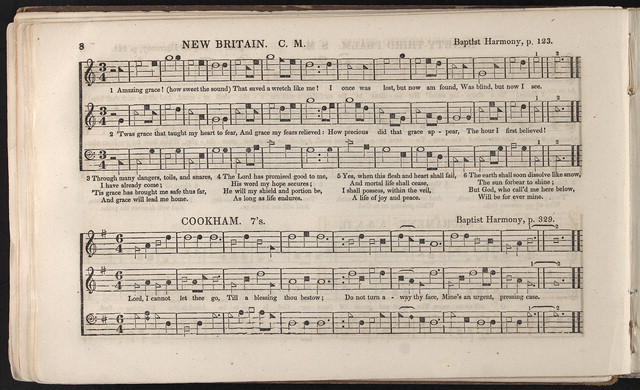
I’ve been interested in Shape Note music for a long, long time, and have been experimenting with the various forms. One predominant form is known as the fuguing tune, which is where you have a homophonic first section, and then a miniature "fugue" to follow.
Can you explain what a fuguing tune is?
It’s not the traditional fugue that Bach would have written, but it does involve the voice parts entering one at a time with the theme or a variant of the theme.
So something like a canon?
Yes! Something like a canon, but canons are the exact same theme coming in at different times.
And where does the text come from?
The words for the fuguing part of this tune come from John Leland, who composed the text for a song called “Ecstasy,” which is in the Sacred Harp [collection of shape note songs], but it seems that his words were loosely based on Psalm 55. I wanted to change the surrounding text of Leland’s chorus, so I composed my own words for the A section to reflect my beliefs about the spirit.
As far as I understand, that’s fairly common to modern-day Shape Note singing, that it’s not necessarily tied to religious observance, practice or belief, but that the singers map their own beliefs or philosophies onto the hymns.
That’s interesting, I hadn’t thought of it that way. There is definitely a resurgence of composers writing in the shape note form. More often, people are using pre-existing texts but getting experimental with the harmonies and the meters.
And are you getting experimental with harmonies?
A bit, yes! I also mess around with the meters from time to time as well.
Have you composed much before this that you’ve released publicly? Personally, I’ve seen things that you’ve written, but have you published or offered your work up for performance?
Well, yes. Most of what I’ve written has been performed by various groups under the Village Harmony umbrella. I’ve been writing in this style for many years now, in this short form. I did write one larger scale called “The Police Log” which is based on the crimes that are listed in the newspaper in Hancock, New Hampshire. The Police Log in Hancock cites such heinous things as a dog digging up somebody’s garden, nothing much more serious than that. That project (commissioned by Jody Simpson) was a lot of fun.
Is that available for public consumption?
I could arrange for that to happen, actually, yes. I also have a piece called "Gordon" that just came out on a new recording by a wonderful group called the Starry Mountain Singers. My pieces are scattered around the internet here and there and on various recordings.
Do you remember the first piece you composed? When did that happen?
Yeah, it was in 1991, when I had broken my wrist — I’m a pianist by training, so the broken wrist put a damper on things, so to speak. I’d been singing Shape Note music for about two years and had gone on a few of trips to England, singing with a group from Vermont that did mostly Shape Note music. I was really fascinated by this style of music, and since I couldn’t play, I decided, alright, I’m going to try to do a little writing. When I first started that in 1991, about six pieces came out right away. They were all based on texts that I really loved and tried to set in my own way with my own style. I’d never written before that. It was surprising to me to find how intrigued I was by the writing process.
How did you get involved with Shape Note singing?
I was singing a concert with my Schola Cantorum in Stratford, Vermont, and a friend in the group had another friend in Vermont who was very involved in the Shape Note community, named Larry Gordon. Larry came to the concert and he and I hit it off and started doing Early Music projects together. Then he introduced me to Shape Note music and I’ve been involved with it ever since then.
There seems to be a link between Shape Note music and Early Music - there are some famous examples of cross-over recordings and performances by Early Music groups. Why do you think that people who are drawn to Early Music have such a draw to Shape Note as well? What is the connection there?
There are similarities in the stark harmonies for starters. Whatever your beliefs are, the spirituality in both of those forms of music is visceral and seems to deeply affect people whether they have a spiritual practice or not. Then there is the “fuguing” aspect, which is connected to the contrapuntal music which you find a lot in Renaissance music. The Boston Camerata and Anonymous Four are good examples of groups that have delved into both genres. I sang on some Shape Note recordings also with the Boston Camerata, and their approach is a little more polished than what my friends in Vermont tend to do in terms of performance practice.
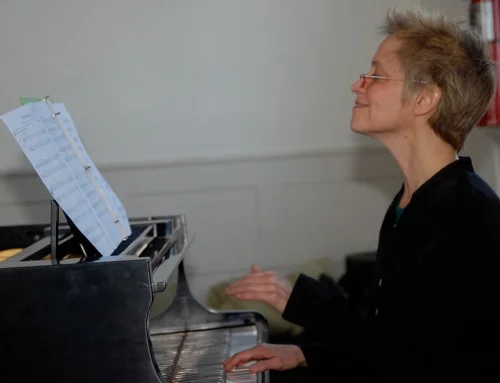
Right; that’s another thing I wanted to ask you about. You are a (very) classically trained musician and pianist, and we at Winsor primarily know you through that kind of work. Shape Note has a very distinct vocal style which is not what a lot of people would consider “classical,” so I am wondering what it’s like for you to move between those two styles, especially as a singer. I know you also sing with Schola Cantorum of Boston and other vocal groups.
I thought you’d never ask! What instantly drew me about Shape Note music was the raw power and energy it has. Having had conservatory training, I was thrilled to see how uninhibited one could be in singing music. When I first started singing Shape Note music with people in Vermont, many of them were [musically] illiterate, but sang with such spirit and such heart; that was what really excited me about that kind of music. There’s not much similarity between singing Thomas Tallis and singing Jeremiah Ingalls, for instance… there’s a lot more chest voice in Shape Note singing and what they like to call the “hard-edged sound,” but in terms of the way I’ve been writing Shape Note music, I don’t tend to write pieces that are meant to be sung at the top of one’s lungs.
That answers my next question, which is: given that this Song for the Spirit is an audience participation portion of the program, and we are not going to be in the traditional square*, how do you intend this piece to be sung? How has our layout of the audience facing the musicians influenced your approach to writing a Shape Note piece?
I also am straying from the original Shape Note form in that, traditionally, Shape Note has the soprano and tenor line doubled up and down the octave. Mine is not meant to be sung that way. It’s really written in standard SATB form, so that’s how we’re going to sing it. The other way that I’m expanding my take on Shape Note music is by putting the melody in the alto line. As an alto myself, this is blatantly selfish! The alto line was usually written last in shape note music and was always by far the most boring line. I'm trying to correct to make that up to my fellow altos! I do also think there's a richness that comes with the melody in a lower register though. It’s probably more fair to say that this piece is written in the Shape Note style, rather than the Shape Note tradition, because of the text that I borrowed from the Shape Note “oevre” and the fuguing tune at the end. But I actually have been questioned: “Why are you even calling it Shape Note music?"
I would just like to point out that the neglect of the alto line is not only true of Shape Note music, that’s also true of traditional hymnody and results in the same problem. We altos are the filler!
Right! I want an interesting alto line, and hopefully with this piece, each line is interesting. I think that’s another real similarity between really intriguing Shape Note pieces and Renaissance music... every line stands beautifully on its own.
Well, not to repeat the question, but you’ve said that the fuguing device is Shape Note, the words are Shape Note, but other than that — because we won’t be in a square*, because we won’t be using that particular vocal technique, because the four part writing is distinctive — what about the piece makes it a “Shape Note piece” as opposed to a piece that uses Shape Note elements?
Visually, the audience will see that it is written in the traditional shapes. Also, the homophonic opening and the "fugue" that follows qualify the piece for that genre. The spiritual nature of the text is also standard fare for the Shape Note style.
So the spirituality of the song is what defines it as Shape Note, because Shape Note is so clearly spiritual?
Writing music, and writing in this style, has been my way of trying to express my own spirituality, which is why I chose to write the text for the first half of this song. I am trying to find ways to secularize spirituality, which I think is appropriate for our time. A lot of people are seeking spiritual direction and nourishment. This is not an easy planet!
What I really wanted to explore in this song was the issue of trust, and hopefully that will be reflected in the text. I was trying to find a way to express my connection to something bigger than myself in a way that more people could relate to. I’m a church musician, and it’s a fact that religious institutions are struggling to keep their membership up. For me, I think it’s so important to live with some sort of spiritual connection. I find it a lot in nature and have set texts in praise of the natural world. I am interested in trying to find and nurture what keeps us strong and gets us out of bed every day...being kind to other people, doing the best we can do here and at the same time sometimes longing for wings to "fly away and be at rest." I think most of us are just trying to live out our highest ideal of what it is to be human here on earth and somehow integrating spirituality into the fabric of our every-day existence.
I think that’s what Peggy was getting at when she created this project.
Perfect! I was first introduced to A Song of Peace (Finlandia) on the Winsor Music series, and now I use that hymn all the time with my church choir. Songs For The Spirit has a ripple effect; Music is one of the very best ways to spread the message of peace and and all of the other goodies we crave.
It sounds like you’ve got quite a bit of work out there! Can we hope for some sort of collected, easily accessible body of what you’ve written?
That’s what I’m hoping to do this year, actually, is get all of these shorter-form works into one handy book. It’s been fun over the decades to see how my writing process has changed - hopefully I’m getting a little better with each song.
Speaking of learning and improvement, you are programmed on this concert with one of your professors from the New England Conservatory! Can you talk a little about what that’s like?
To be on the same program as Professor Heiss is a great honor, because he was one of my very favorite teachers at the Conservatory. I studied Twentieth Century Music with him. He was an inspiring, invigorating, and refreshing teacher... brilliant, articulate, kind and very approachable. He made a difficult kind of music that initially seemed intimidating very accessible. He piqued my interest in twentieth century music to the point where I started writing some of my own!
*The “square” referenced here is the traditional seating arrangement for Shape Note singing. A square is constructed using one or more concentric rows of chairs in which all singers are seated, including during performance. One singer traditionally stands in the center of the square to call the next song and lead it by keeping time, very simply in two beats, by raising and lowering their hand and forearm. The square is central to the distinctive sound of Shape Note because there is a dramatic acoustic difference between being a participant, sitting in the square, and an observer, standing well outside of the square. One cannot really attend a traditional “sing” as a removed observer in the way that classical audiences do because one cannot really hear the music unless one is in the square; even the word used to refer to occasions of Shape Note music-making is indicative of this complete breakdown between audience and musician. There are no performances, there are only “sings.”

An Interview with Mitsuru Yonezaki, violin
Mitsuru Yonezaki is our featured young artist for the first concert of our 2015-16 season, and a founding member of Winsor Music's first mentoring ensemble, Violobos! She began her violin studies at the age of four and currently studies with Joanna Kurkowicz. She took time out of her busy schedule to speak with us about how she has embraced chamber music, how singers and wind players like Peggy inspire her, and how music fits into her present and future.
Mitsuru Yonezaki is our featured young artist for the first concert of our 2015-16 season, and a founding member of Winsor Music's first mentoring ensemble, Violobos! She began her violin studies at the age of four and currently studies with Joanna Kurkowicz. Having enrolled at the New England Conservatory Preparatory School under Fudeko Takahashi (2004-2013), she has become the youngest member of many orchestras, including their top orchestra, the Youth Philharmonic Orchestra, at age 11. She has been selected as the winner of various competitions including NEC Prep School’s competitions (category B - 2nd, 2013), the Kobe International Competition (2011, Grand Prize and Special Award for Artistic Excellence), and Newton’s Classical Idol Competition (January 2010). Mitsuru is currently a member of the Boston Philharmonic Youth Orchestra, led by Maestro Benjamin Zander, which toured the Czech Republic, Germany and Switzerland this past June to perform in 9 different halls, some of which include the Smetana Hall in Prague, Berliner Philharmonie in Berlin, and Kultur und Kongresszentrum in Luzern.
When Mitsuru is not practicing or at school, she enjoys cooking, reading, and spending time with her friends sight-reading music. She took time out of her busy schedule to speak with us about how she has embraced chamber music, how singers and wind players like Peggy inspire her, and how music fits into her present and future.
You are a rising junior in high school?
Sort of - I’m also completing my senior year now. I’m taking the courses that I need to graduate.
So you’re going to be done at the end of this year?
Yes.
What’s the plan after that?
Hopefully going to a music school.
It says in your bio that you’ve been playing the violin since you were four years old. How did you start?
My sister, who also plays the violin, was my inspiration - I frequently went with her to her lessons, watched her practice, and it kind of made me curious about music, so I also started the violin.

Photo credit: Kendra Colton
Did you ask for lessons when you were four?
Yes, I did.
Why did you stick with it? A lot kids start, but not a lot of kids get to the point that you’re at now.
I just really liked all of the repertoire I had to explore. I was doing orchestral and solo music, and some duets with my sister, and I think there’s still so much to learn, both musically and repertoire-wise. I just really enjoyed making music. — You never got bored. — Yes.
Did you imagine or hope when you were younger that music would be such a huge part of your life now?
I guess to a certain extent, I expected myself to keep working with it, but I wasn’t sure how it would turn out. At first it was more of a thing that I liked to do, but now it’s a huge part of my life.
Do you remember the first chamber group that you participated in? What did you play? What was the experience like?
Yes, I do. My first real chamber group was the summer of 2012 at camp, that was when I was first exposed to it. I remember playing Mendelssohn Op. 44, No. 3, 2nd movement. Everyone else in the group had been at the camp for a while, so they were helping me through the process. They made a big impression on me, concerning chamber music. They made everything about rehearsal seem so fun and interesting, even when it was the tedious things that you have to work through, they would make it fun. Having different people lead, exchanging the parts. Everything about it became really fun.

If your first chamber group was in 2012, how many years had you been playing violin prior to that experience?
Around nine years.
That’s a lot of experience as a violinist before you ever got into a chamber setting. Was it a shift for you? When you say they were helping you work through the process, what did you have to work through as you were making that adjustment?
I had to learn how to really listen for other people, and respond to and interact with what they were giving me. Because I was playing second violin, I had to make sure that I wasn’t playing second violin underneath; it has to be equally as strong as the first violin. I think that was a different experience; sometimes the first violin feels more like the soloist in an orchestra. To play second violin was to support the group but also sometimes have these moments where you shine out. That was a different idea that I sometimes now use in my solo playing as well to vary phrases, when I want to be more intimate or reserved, that second violin instinct kicks in and helps me do that.
You had been playing in orchestras before you started playing chamber music. How old were you when you started playing in orchestras?
I began at the NEC String Training Orchestra when I was five, and I first got into an orchestra with winds and brass when I was six.
So you have been in orchestras for as long as you’ve been playing. When you were making that adjustment to chamber music, were you adjusting from being a soloist, or adjusting from being an orchestral player, or a little bit of both?
It was a little bit of both, because in the orchestra, you have your whole section to play with you, so you try to play with each other. In that sense, playing with each other [in a chamber group] wasn’t that big of a change from the orchestra, but in the sense that you’re the only one on the part, it was an adjustment, so I think it was a mixture of being a soloist and in an orchestra. I was finally coming to the middle of those two extremes, of being part of a group and being the only one.
I know you spent part of your summer on tour with the BPYO, and part of your summer at the Perlman Music Program, an intensive music camp. Can you tell me about both of those experiences?
For the tour, we got to experience different cultures and different foods, which I really liked. All of these places that we performed at and visited gave me more insight into the composers’ mind. We visited some Jewish museums, which gave me some ideas around some European Jewish composers. Playing at these great halls was just… it was mind-blowing that we were all there. We also got to listen to the Berlin Philharmonic. I happened to have a seat that was behind the timpanist for that concert, so I was watching the conductor and observing how people from that angle were interacting with each other and with the conductor. It gave me some ideas as to how I could change as an orchestral musician. I was mainly observing the principal stands to learn more about leading and how they do it. I thought it was incredible that they would give small cues, but because they were slightly turned in, everyone would see that and do the same. That was one of the things I learned there: even the smallest gesture can make a big difference if you let show to others.
At camp [the Perlman Music Program], because I was one of the older campers there, who had been there longer, I got to experience being a kind of mentor to some of them. There were some people new to chamber music, so it was like my first summer but the roles were reversed. I got to help with the rehearsal process - giving ideas on how we wanted to phrase things. Because we also do singing at camp, that gave me different ideas, because when you sing you have to breathe. When I play violin, I don’t need to take breaks, so by singing, it helped me. During practice, I would sing a little to figure out where I needed to take “breaths” or make a phrase.
So singing is a part of the core curriculum at your camp? What kind of repertoire were you doing?
It’s choral repertoire, some Schubert, Handel, and a piece by Gyorgy Orban in Latin about the devil. It was very intense and in a different style from the beautiful tunes by the other composers. I think they intended for us to have a variety. They said that singing could give you new ideas about how to phrase, and thinking about breathing.

Photo credit: Kendra Colton
Along those lines, what has it been like for you, in your experiences with Violobos, to work so closely with a wind player/instrument? I know it’s not necessarily something that other young string players experience. Has it affected you in any way?
Playing with a wind instrument, especially the oboe, has changed my playing because when I’m playing with another violinist, we both know how loud and soft we can play. With wind players, it’s a different kind of range. It’s probably easier for the strings to adjust to the wind player, and the breathing comes in again. I’m still working on blending to [Peggy’s] sound, but I think I’m getting better.
As a string player, what is involved when you’re working to blend with Peggy (or anyone, for that matter)?
I mainly listen. Because the oboe has a more naturally — I don’t know what the right word is — angular? — sound, I try to focus on my contact point. I also try to take cues from the way that she breathes. If she takes a slower breath, I feel like it’s supposed to be a warmer sound.
When you talk about your bow placement in regards to her more angular sound, are you trying to match her sound or complement it?
Sometimes I try to match her sound, especially when we’re playing similar rhythms to each other. When I’m playing, for example, a counter-melody or the bass line, I try to complement it so that her voice comes out more than mine.
What are you most looking forward to about this concert?
It’s a different group of people, I’m excited to be working with these people. I recognized one name - the cellist, Rafael Popper-Keizer — because I know him as the principal of the Boston Philharmonic. I’m looking forward to working with these people who are much more experienced than me. I also like working with people my own age, but learning from the more experienced players is always fun.
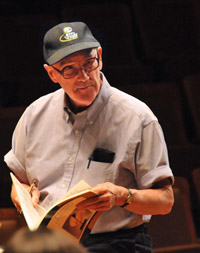
Composer John Heiss
Is there a piece that stands out to you at this stage of preparation?
I’m excited about Mr. Heiss’ piece because I’ve heard of him, as a living composer. Some of the ways that he wrote reminded me of Schoenberg, so I’ve been trying to compare other contemporary works with this piece, and it’s been really fun.
What role has music played in your life so far? Is it a supplement to your other activities or is everything else a supplement to music, or is there a balance?
I think music is a balance for me. It helps me in my academics, but then there is the math in music, so academics comes into music. It goes both ways, but I see music as my main focus.
Is it too soon to ask what your plans are for the future? You mentioned that conservatory is on the horizon.
I am going to try to pursue a career in music performance. I want to go to conservatory or any school with a teacher that I would love to work with. I want to make my music unique to me and figure out how to present myself as an individual and make sure my technique is well-polished.
Peggy's Notes on Our Season of Haydn
As an oboist, I often think I am the luckiest person alive because I have the Bach cantata repertoire. Perhaps this should be enough to keep an oboist going! However, as the artistic director of a chamber series (who enjoys performing), I struggle with the fact that the chamber music repertoire for oboe is limited. Coming up with programs involving the oboe is a challenge, but it's a good challenge to have.

As an oboist, I often think I am the luckiest person alive because I have the Bach cantata repertoire. Perhaps this should be enough to keep an oboist going! However, as the artistic director of a chamber series (who enjoys performing), I struggle with the fact that the chamber music repertoire for oboe is limited. Coming up with programs involving the oboe is a challenge, but it's a good challenge to have. That is why I have been commissioning new compositions and transcribing classical works for oboe since we started Winsor Music.
When I do a transcription, I try hard not to annoy my audience and musician friends by avoiding pieces that are well-known or performed often. Early on, I started with rarely performed Bach and Brahms organ works; I moved on to Webern, Landini and Clara Schumann. John Harbison was the one who suggested I take a look at Haydn.

Professional string quartets are playing less and less Haydn: Hah! what are they thinking? I love Haydn, and if they are not going to play Haydn, I am. If I can make a string quartet work for oboe, I’m going to arrange it!
So when one of my board members suggested that I should program Haydn on every concert, I went for it. The Haydn trio on Sunday’s concert was originally composed for flute, cello and piano. I programmed this work because it is a concise and spirited piece, and because I love playing it-- but more importantly, I really wanted to play with George Li!
We would like to take this opportunity to announce that Peggy's transcription of Haydn's Quartet in D Minor, Op. 42, No. 1, is now available as a digital download!

Franz Josef Haydn’s darkly evocative Quartet in D minor, composed in 1785, arranged to include oboe by Peggy Pearson, and here available as a PDF download.
Quartet in D minor, Op. 42, Hob. III:43
1. Andante ed innocentemente
2. Menuetto. Allegretto – Trio
3. Adagio e cantabile
4. Finale. Presto